Last updated:
Hampi, on the south bank of the Tungabhadra river in central Karnataka, was the heart of Vijayanagara, the capital of the great empire that ruled much of South India from the 14th to the 16th century. Today its temples, palaces and bazaars lie scattered across a striking landscape of granite boulders, banana groves and river channels. The Group of Monuments at Hampi was inscribed as a UNESCO World Heritage Site in 1986.
Hampi is not only a heritage site. The Virupaksha temple has never stopped worship, and for pilgrims the whole area is sacred as Pampa Kshetra and as part of the Kishkindha of the Ramayana.
On this page
Main temples
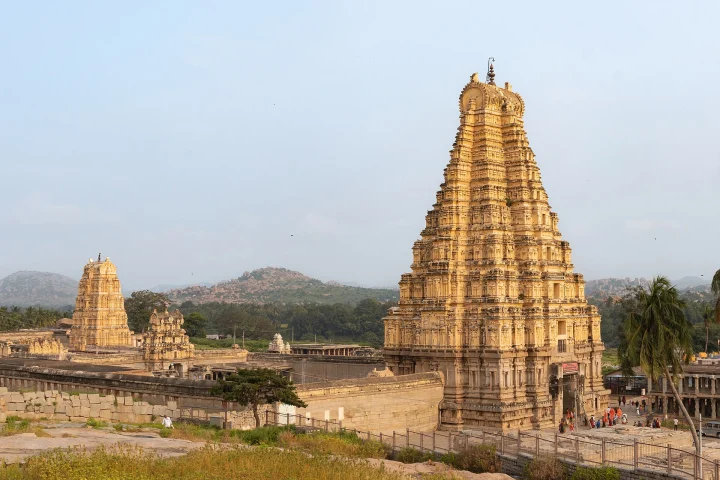
Virupaksha Temple
Lord Shiva is worshipped here as Virupaksha (also called Pampapati), with Goddess Pampa, after whom the river was once named. The temple’s tall eastern gopuram rises above the old Hampi Bazaar street, and an inner hall has painted ceilings from the Vijayanagara period. This is the one temple in Hampi with full daily worship. See the Virupaksha Temple, Hampi page.
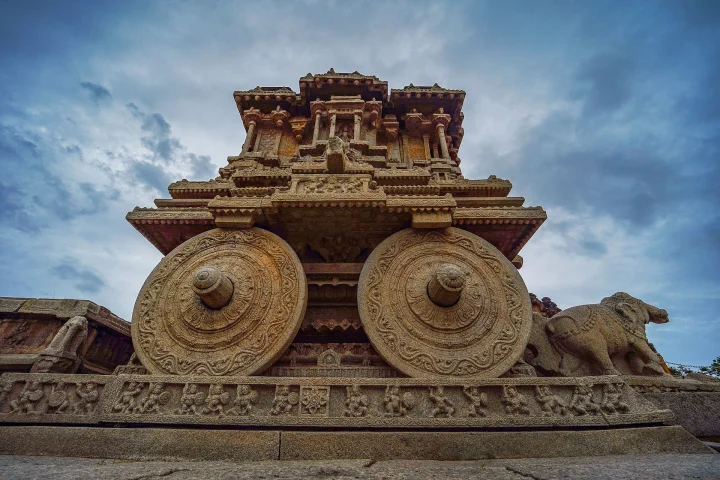
Vittala Temple
Dedicated to Lord Vishnu as Vittala, this temple complex shows Vijayanagara art at its finest: the famous stone chariot (a shrine for Garuda), and great mandapams with slender pillars, some of which are known as musical pillars. It is a protected monument rather than a functioning temple, and an entry ticket is charged by the Archaeological Survey of India. See the Vittala Temple, Hampi page.
Other sacred sites
- Hemakuta hill, with early shrines and wide views over Virupaksha.
- The giant monolithic Lakshmi Narasimha, seated under the hood of a serpent, and the Badavilinga beside it, standing in water.
- The Sasivekalu and Kadalekalu Ganesha statues on the slope of Hemakuta.
- The Hazara Rama temple in the royal centre, its walls carved with the Ramayana.
- The Kodandarama temple by the river, and Anjanadri hill on the north bank, which local tradition holds as the birthplace of Hanuman.
History in brief
Vijayanagara was founded in the 14th century by Harihara and Bukka of the Sangama dynasty. Under rulers such as Krishnadevaraya in the early 16th century it became one of the largest and richest cities of its time, admired by foreign travellers. In 1565, after the battle of Talikota, the city was sacked and abandoned. Its temples and ruins were left largely as they fell, which is why Hampi feels so different from the living temple towns of Tamil Nadu.
Visiting tips
- Distances inside Hampi are large; our car takes you between the main clusters, and some areas are best covered on foot.
- Start at sunrise and rest in the middle of the day – the rocks reflect a lot of heat.
- Carry water, a hat and comfortable footwear for the monuments; footwear comes off only at shrines in worship.
- The Vittala temple and some other monuments have ASI entry tickets and set hours, at the time of writing – check before you go.
- Dress modestly at Virupaksha; the temple closes for a short time in the afternoon.
Festivals
- The Virupaksha chariot festival in spring (around February–March), following the Hindu calendar.
- The celestial wedding of Virupaksha and Pampa, celebrated in the winter months.
- Hampi Utsav (also called Vijaya Utsav), a cultural festival held by the state government, with dates announced each year.
- Maha Shivaratri (February–March) at Virupaksha.
A simple 2-day plan
Day 1: morning darshan at Virupaksha, then Hemakuta hill, the Sasivekalu and Kadalekalu Ganeshas and the Lakshmi Narasimha monolith with the Badavilinga. After a midday rest, visit the royal centre – the Hazara Rama temple, the Mahanavami platform and the stepped tank – and return to Hemakuta or Hampi Bazaar for sunset.
Day 2: start early at the Vittala temple before the heat and the crowds, walk along the river past the Kodandarama temple, and in the afternoon cross towards Anegundi and Anjanadri hill. The climb to the Anjaneya shrine on Anjanadri is long, with many steps; it is best in the late afternoon.
Hampi also fits into a longer Karnataka yatra with the coastal Karnataka temples, though the drive between them is a full day.
Where to stay
Hosapete, about 12 km away, has the widest choice of hotels. There are also guest houses at Kamalapura near the royal centre and resort-style stays in the surrounding countryside. We book a hotel of your choice on request.
How to reach
From Pondicherry: about 620 km, around 12 hours by road via Bengaluru. Split the journey, or travel by train to Hosapete.
From Trichy: about 670 km, 12–13 hours by road via Bengaluru.
Hosapete Junction is the nearest railway station. See our Hampi temples tour, or book a car with driver for your own plan.
Frequently asked questions
How many days are enough for Hampi?
Two full days let you see Virupaksha, Vittala, Hemakuta hill, the royal centre and the river sites without rushing.
Is the Virupaksha temple still in worship?
Yes. Virupaksha is a living temple with daily pujas, unlike most monuments at Hampi.
Which is the nearest railway station to Hampi?
Hosapete Junction, about 12 km away.
When is the best time to visit Hampi?
October to February. April and May are extremely hot.