Last updated:
In the old quarter of Mylapore, a tall painted gopuram rises over narrow streets of flower sellers, brass shops and old houses. This is the Kapaleeshwarar Temple, the best-known Shiva temple in Chennai and the spiritual heart of Mylapore. Shiva is worshipped here as Kapaleeshwarar, and Goddess Parvati as Karpagambal, the mother of the wish-granting tree.
The temple is a Paadal Petra Sthalam, praised in the Tevaram hymns of the Nayanmar saints Sambandar, Appar and Sundarar. It is run by the Hindu Religious and Charitable Endowments (HR&CE) Department of Tamil Nadu. For many families, a Chennai temple day starts here and moves on to the nearby Parthasarathy Temple in Triplicane.
On this page
The deity and the legends
The name joins kapala (skull or head) and Ishwara (Lord). According to the Puranas, Brahma once failed to show Shiva due respect on Mount Kailash, and Shiva removed one of Brahma’s five heads. Brahma later came to this place to worship Shiva and win back his power of creation.
The legend most loved by pilgrims is that of the peahen. Tradition says Parvati was born as a peahen (mayil in Tamil) and worshipped Shiva here until she regained her own form. That story gave the area its name, Mylai, which became Mylapore. Images in the temple show the Goddess as a peahen worshipping the lingam.
Another story is linked with the child saint Thirugnana Sambandar. According to the Periya Puranam, a merchant named Sivanesar had kept the bones and ashes of his daughter Poompavai, who had died of a snake bite. Sambandar sang a set of ten verses here, and tradition says the girl came back to life. Poompavai has a small shrine in the temple.
History and architecture
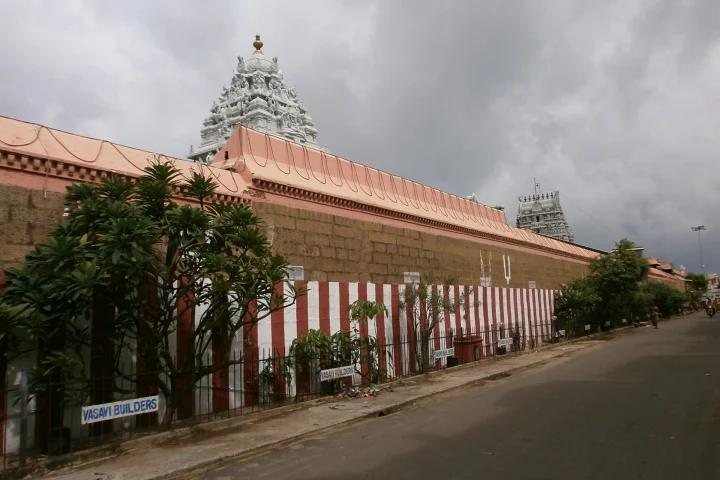
The Tevaram hymns and the later poet Arunagirinathar place the temple near the seashore, and most historians think the original Pallava-era shrine stood closer to the sea. The present temple was built in its current place around the 17th century, and the main gopuram, about 120 ft (37 m) tall, dates from 1906. It is covered with brightly painted stucco figures of gods, saints and stories.
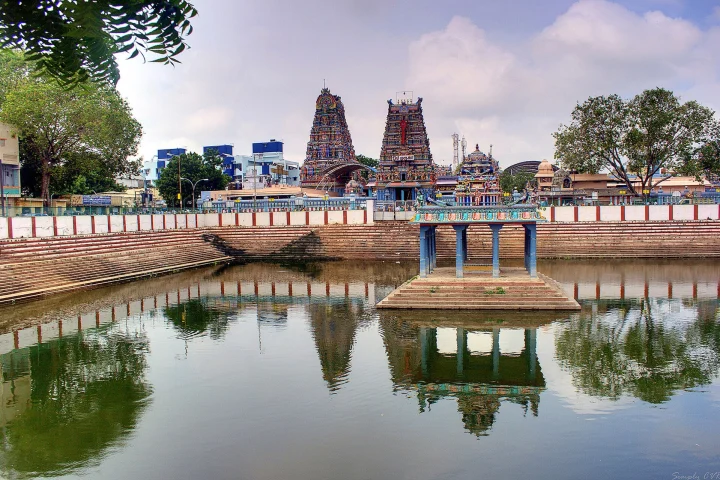
- The temple tank: the large tank to the west of the temple, about 190 m by 143 m, holds water through the year. The deities are taken round it on a decorated float during the float festival.
- Shrines in the corridor: look for Singaravelan (Murugan), praised by Arunagirinathar in his Tiruppugazh, a dancing Vinayaka, and the shrines of Poompavai and Vayilar Nayanar, one of the 63 saints, who is said to have been born in Mylapore.
- The Mylapore streets: the four streets around the temple are where the festival chariot and the procession of the 63 Nayanmars pass.
Darshan tips
- Mornings before 9 am and evenings after 5 pm are usually calmer. Pradosham days and the new-moon and full-moon days bring larger crowds.
- Worship at the Kapaleeshwarar sanctum first and then at the Karpagambal shrine, as most local families do.
- Leave footwear at the stand near the gopuram. The stone floors can get hot by noon.
- The Panguni festival (March–April) is the high point of the year, especially the day of the 63 Nayanmars’ procession, when the streets are packed from early morning. Plan for slow traffic and park well away from the temple.
- Mylapore is a busy neighbourhood with limited parking; our driver will drop you near the gopuram and wait nearby.
Dress code, phones and photography
Wear modest, traditional clothes. Follow the notice at the gate; at the time of writing many temples allow phones only if switched off; photography inside is not allowed. Our temple dress code guide explains what is usually expected at Tamil Nadu temples.
How to reach
From Pondicherry: about 145 km by road along the East Coast Road, usually 3½ to 4 hours depending on Chennai traffic. Many pilgrims leave Pondicherry by 5 am so they reach Mylapore for the morning darshan.
From Trichy: about 330 km, roughly 6 to 6½ hours by the national highway. Most pilgrims from Trichy either spend a night in Chennai or come by train or flight and use our car from there.
The temple is about 15 km from Chennai airport and about 7 km from Chennai Central and Egmore stations. Thirumayilai station on the suburban MRTS line is a short walk away.
What to combine it with
The Parthasarathy Temple is only about 3 km away, and the Vadapalani Murugan Temple about 10 km. Together they make a full day, which is the core of our Chennai temples day tour from Pondicherry. Read our Chennai temples guide and the Chennai temple town page to plan the day, or contact us for a car with driver.
Frequently asked questions
What are the Kapaleeshwarar Temple timings?
HR&CE lists the temple as open about 5:30 am to 12:30 pm and 4:00 pm to 9:30 pm, and through the night on Maha Shivaratri. Timings can change on festival days, so check before you go.
Why is the area called Mylapore?
According to tradition, Goddess Parvati worshipped Shiva here in the form of a peahen, mayil in Tamil. The place came to be called Mylai, which later became Mylapore.
When is the Arupathimoovar festival?
It is part of the ten-day Panguni festival in March–April, when the images of the 63 Nayanmar saints are taken in procession with Kapaleeshwarar. The exact date changes each year with the Tamil calendar.
Can I visit Kapaleeshwarar Temple on a day trip from Pondicherry?
Yes. It is about 145 km, roughly 3½ to 4 hours each way, so a day trip works well if you leave early. Many families add the Parthasarathy and Vadapalani temples the same day.