Last updated:
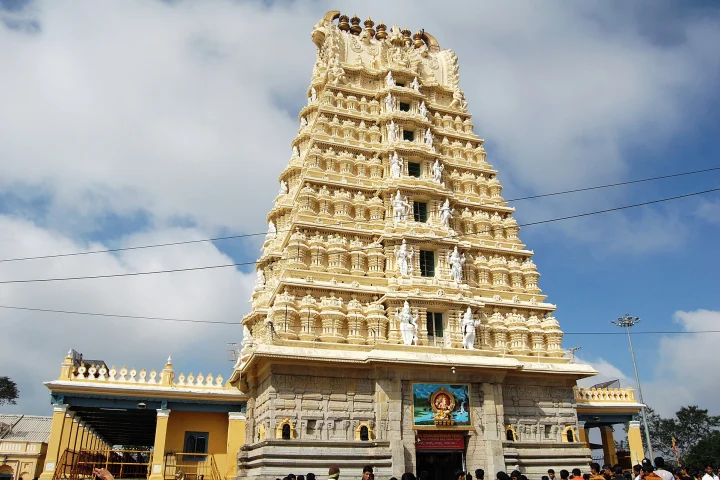
About 25 km south of Mysuru, on the right bank of the Kapila (Kabini) river, the town of Nanjangud has grown around one of the largest temples in Karnataka. The Srikanteshwara Temple, which local people call the Nanjundeshwara temple, is so revered that the town is known as Dakshina Kashi – the Kashi of the South.
With Chamundi Hills and Srirangapatna, it makes a natural part of a Mysuru temple trip.
On this page
The deity and the legend
The name Nanjundeshwara means the Lord who swallowed poison. According to the Puranas, when the ocean was churned by the devas and asuras, the deadly halahala poison rose first, and Shiva drank it to save the world; it stayed in his throat, turning it blue. The town’s name, Nanjangud, means the abode of Nanjundeshwara, and the Shiva Purana is said to call the place Garalapuri.
Other local legends link the site with the sage Parashurama’s penance – a small Parashurama shrine stands nearby – and with a visit of Parvathi. Many devotees come to pray for healing; the deity is affectionately remembered as a divine physician.
History in brief
- The temple’s origins are traced to the Ganga period. The sanctum is dated to the Chola period (around the 11th century) and the front hall to the Hoysala period (around the 13th century).
- The Vijayanagara period added the brick tower over the sanctum and the shrines of Parvathi and Narayana.
- The Wodeyars of Mysore built the great gopuram and several halls. A stone Nandi about eight feet tall was installed in 1644.
- Tradition says Tipu Sultan, after his royal elephant’s eye was cured with the temple’s holy water, gifted a jade (maragatha) lingam and called the deity Hakim Nanjunda – Nanjunda the physician.
Architecture highlights
- The gopuram, about 120 feet tall, built in 1845 by Devarajammanni, a queen of Krishnaraja Wodeyar III, and crowned with seven gilded kalashas.
- A vast complex of about 385 by 160 feet, among the largest temples in Karnataka.
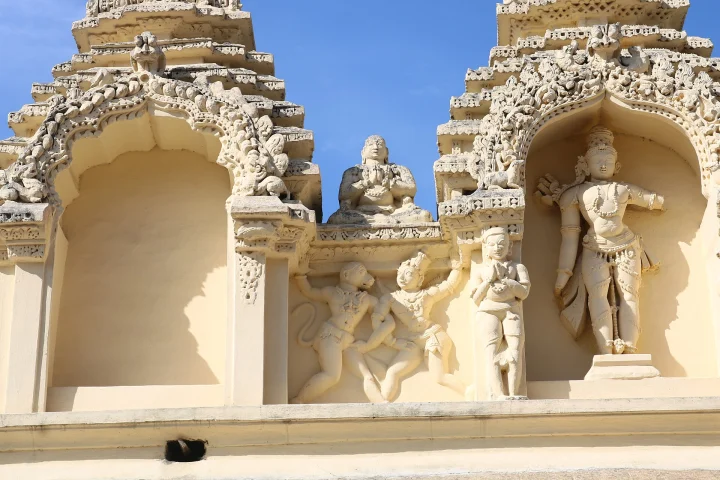
- Niches along the enclosure wall with more than a hundred images of Shiva, and dozens of Shiva lingas inside the temple.
- A sculpture of Krishnaraja Wodeyar III with his queens.
Darshan tips
- Some devotees bathe in the Kapila river before darshan. In the monsoon the river can be high; bathe only where others do.
- Mondays are busy; weekday mornings from Tuesday to Friday are calmer.
- The temple has many shrines along its corridors. Allow time to walk the full circuit after the main darshan.
- Carry very little. Footwear and bags are left outside; follow the notice at the gate on phones and photography.
Festivals
The Dodda Jatre, or Pancha Maharathotsava, is the great annual festival, held around Chaitra Purnima (March–April). Five decorated chariots are pulled along the chariot street by thousands of devotees; in 2026 it was held at the end of March. Maha Shivaratri also brings large crowds.
What to wear
We could not find a published dress code for the temple. Dress as you would for any major South Indian temple: men in a dhoti, or trousers with a shirt; women in a saree, salwar kameez or long skirt. Shorts and sleeveless tops are best avoided. Footwear is left outside, and photography of the sanctum is not allowed.
If you are coming from Kerala the same week, note that the Kerala custom of men removing their shirts is not the general practice in Karnataka temples; follow the notice at the gate.
Planning your visit
Nanjangud lies on the road from Mysuru towards Gundlupet and Ooty, so it fits well at the start or end of a Mysuru trip. On the route from Trichy through Erode and Chamarajanagar, Nanjangud comes before Mysuru – a natural first darshan of the trip. Allow extra time for long queues on Mondays and at Shivaratri.
How to reach
From Trichy: about 365 km by road, roughly 8 hours via Karur, Erode, Sathyamangalam and Chamarajanagar.
From Pondicherry: about 455 km, roughly 9–10 hours; we usually break the journey overnight. Many pilgrims take a train or flight to Mysuru or Bengaluru and use our car from there.
Nanjangud has a railway station, and Mysuru is about 25 km away. Mysuru airport is the nearest airport. See the Mysuru temple-town guide.
Combine it with
- Chamundeshwari Temple, about 30 minutes away.
- Srirangapatna Ranganathaswamy Temple and Melukote, north of Mysuru.
- Our Mysuru and Srirangapatna temples tour.
Frequently asked questions
Why is Nanjangud called Dakshina Kashi?
The great Shiva temple on the sacred Kapila river makes the town as holy to devotees as Kashi, so it is called Dakshina Kashi, the Kashi of the South.
What does Nanjundeshwara mean?
The Lord who swallowed poison. It refers to Shiva drinking the halahala poison during the churning of the ocean.
When is the Nanjangud Dodda Jatre?
Around Chaitra Purnima, in March or April. Five chariots are pulled through the town. Check the date each year with the temple.
Is Nanjangud temple open all day?
On Sundays and Mondays it is usually open through the day. On other days it closes for a few hours in the afternoon. Check before you go.
How far is Nanjangud from Mysuru?
About 25 km, around 30–40 minutes by car.