Last updated:
In the village of Alangudi, among the paddy fields about 18 km south of Kumbakonam, stands the Navagraha temple of Guru, the planet Jupiter. The temple belongs to Shiva as Apatsahayesvarar, “the lord who comes to help in times of danger”, but most pilgrims come for Dakshinamurthy, Shiva in the form of the silent teacher, who is worshipped here as Guru. The village lies in Valangaiman taluk of Thiruvarur district.
The nine Navagraha temples around Kumbakonam are Suriyanar Koil (Sun), Thingalur (Moon), Vaitheeswaran Koil (Mars), Thiruvenkadu (Mercury), Alangudi (Jupiter), Kanjanur (Venus), Thirunallar (Saturn), Thirunageswaram (Rahu) and Keezhperumpallam (Ketu).
On this page
The legend
According to tradition, when the gods and demons churned the ocean of milk, a deadly poison rose up and threatened the world. Shiva drank it to save creation. The temple remembers this act of protection: Apatsahayesvarar is the one who rescues his devotees from danger, and local tradition connects the name of the village with the poison (aalam) that Shiva swallowed.
Goddess Elavarkuzhali has her own shrine. The temple is a Paadal Petra Sthalam: Tirugnana Sambandar and Appar both sang hymns in its praise. The original shrine is believed to go back to the Chola period, and the present stone structure dates largely from the Nayak period in the 16th century.
Guru and his worship
In Tamil astrology, Guru (Jupiter) is the most benevolent of the planets, linked with wisdom, children, marriage, prosperity and good conduct. At Alangudi he is worshipped through Dakshinamurthy, whose shrine is on the south side of the main sanctum, the traditional place for this form of Shiva.
Thursday is Guru’s day, and the temple is busiest then. Traditional offerings include yellow cloth, garlands of Bengal gram (kondakadalai), yellow flowers and ghee lamps. Pilgrims often come during the yearly Guru Peyarchi, when Jupiter moves into a new sign; special homams and archanas are held and the crowds are very large. Ask at the temple counter about parihara poojas. Our Navagraha temples guide explains each planet’s traditions.
Who is Dakshinamurthy?
Dakshinamurthy is Shiva as the supreme teacher. He is traditionally shown seated under a banyan tree, facing south (dakshina), teaching the four sage-sons of Brahma through silence rather than words. One foot rests on a small figure representing ignorance, and his hand forms the gesture of knowledge. In almost every Shiva temple in Tamil Nadu he has a niche on the southern wall of the sanctum, and on Thursdays devotees light lamps before him. At Alangudi this familiar form takes centre stage, and pilgrims come specifically to seek Guru’s blessing.
The temple and its tanks
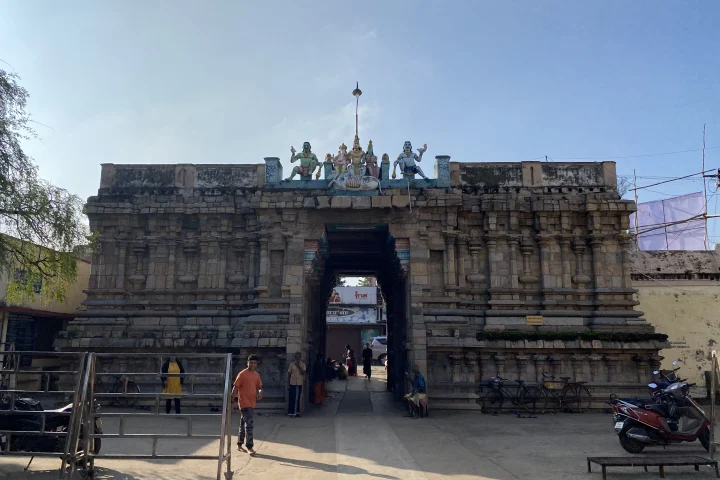
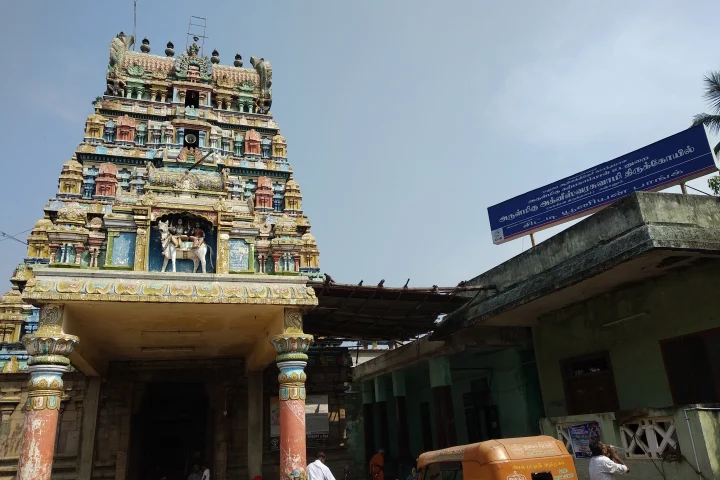
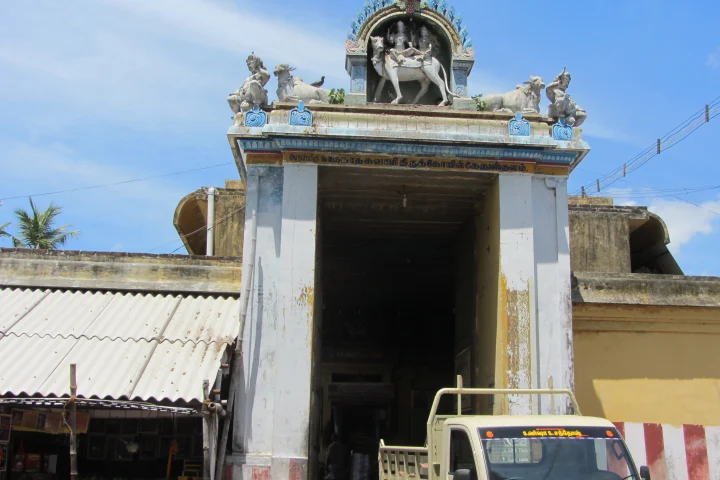
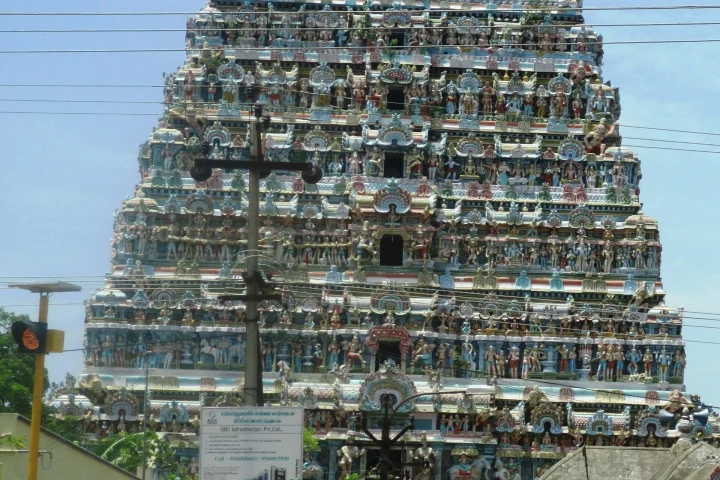
The temple has a tall, brightly painted gopuram and a peaceful courtyard. It is associated with many sacred water bodies around the village, and the main temple tank lies close to the complex. It is a working village temple, and outside Thursdays and Guru Peyarchi it is usually calm, a good place to sit quietly after darshan.
Darshan tips
- Come on a Thursday morning if you want to worship on Guru’s day; on other days the temple is quieter.
- Buy yellow cloth, Bengal gram garlands and flowers from the stalls outside.
- Worship Apatsahayesvarar and Elavarkuzhali before going to the Dakshinamurthy shrine, as is the local custom.
- Leave footwear at the entrance.
- Check the temple’s announcement for the date of Guru Peyarchi; it may differ from some almanacs.
Dress code, phones and photography
Dress modestly in traditional clothes. Phones may have to be deposited, and photography of the deities is not allowed. See our temple dress code guide.
How to reach
From Trichy: about 95 km by road, roughly 2½ hours via Thanjavur.
From Pondicherry: about 160 km by road via Chidambaram and Kumbakonam, roughly 3½ to 4 hours.
Alangudi is about 18 km (30 minutes) south of Kumbakonam railway station. The nearest airport is Tiruchirappalli International Airport.
What to combine it with
Alangudi is part of our Navagraha temples tour with Suriyanar Koil, Thirunageswaram and Thirunallar. It also fits well on the road from Thanjavur to Kumbakonam. Base yourself in Kumbakonam.
Frequently asked questions
Which planet is worshipped at Alangudi?
Guru, the planet Jupiter, worshipped through Dakshinamurthy, the teacher form of Shiva.
What is the best day to visit Alangudi?
Thursday, Guru’s day, though it is also the busiest. Guru Peyarchi, Jupiter’s yearly change of sign, draws the largest crowds.
What should I offer at Alangudi?
Traditional offerings include yellow cloth, Bengal gram garlands, yellow flowers and ghee lamps. The priests can advise on parihara poojas.
How far is Alangudi from Kumbakonam?
About 18 km, or roughly 30 minutes by car.