In Hindu astrology, nine celestial bodies – the Navagrahas – are believed to shape a person’s fortunes: the Sun, the Moon, Mars, Mercury, Jupiter, Venus, Saturn, and the two shadow planets Rahu and Ketu. When an astrologer finds one of them unfavourable in a horoscope, the usual advice in Tamil Nadu is to visit that planet’s temple and offer prayers. In the fertile Kaveri delta around Kumbakonam, there is a temple for each of the nine, all within a day’s drive of each other.
This guide introduces each temple, explains how pilgrims usually plan the circuit, and shares practical tips from our drivers, who make this trip every week. For a ready-made itinerary, see our Navagraha temples tour or the Navagraha circuit page.
On this page
A note on how these temples work
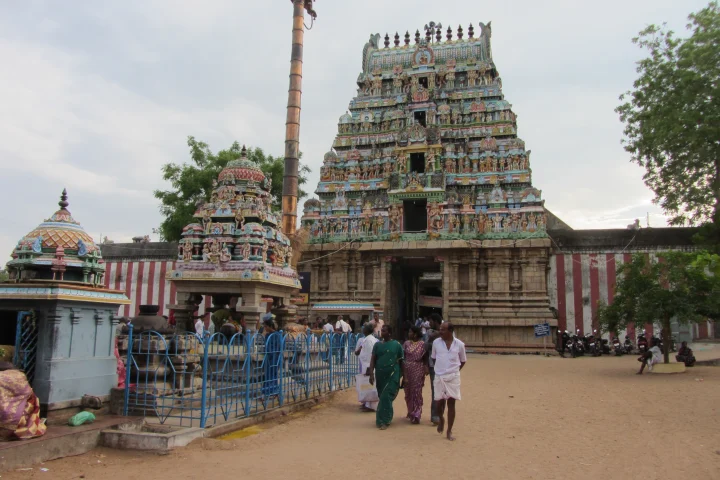
Apart from the Sun temple at Suriyanar Koil, the Navagraha temples are Shiva temples. In each, Shiva is the main deity in the sanctum, and the planet is worshipped in a shrine within the complex, often with a story linking the planet to Shiva’s grace at that place. So a visit usually means darshan of Shiva and the Goddess first, and then the planet’s shrine, where the parihara (remedial) poojas are done.
Most temples have counters where you can book an archana or a specific pooja for the planet. The priests explain the offerings – for example, particular coloured cloths or grains associated with each planet. Follow their guidance rather than any list you read online, as customs vary between temples.
The nine temples
Sun (Surya) – Suriyanar Koil
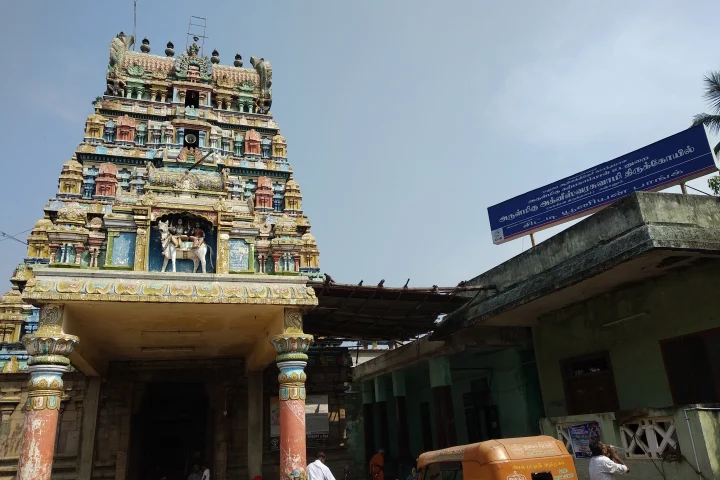
Suriyanar Koil, about 15 km north-east of Kumbakonam near Aduthurai, is the only temple in the circuit where the Sun is the main deity. Surya stands with his consorts, and the other eight planets have their own shrines around him. The temple is attributed to the Chola period. By tradition, pilgrims begin the circuit here.
Moon (Chandra) – Thingalur
The Kailasanathar Temple at Thingalur lies near Thiruvaiyaru, west of Kumbakonam towards Thanjavur. “Thingal” is a Tamil word for the moon. Pilgrims seeking peace of mind and relief from the moon’s effects come here.
Mars (Angaraka) – Vaitheeswaran Koil
The Vaidyanathaswamy Temple at Vaitheeswaran Koil, near Sirkazhi, honours Shiva as the divine healer (Vaidyanathan). Angaraka, the planet Mars, has a shrine here, and many pilgrims come to pray for health. The town is also known for its palm-leaf Nadi astrology readers, who work outside the temple.
Mercury (Budha) – Thiruvenkadu
The Swetharanyeswarar Temple at Thiruvenkadu, near Poompuhar, has a shrine to Budha, associated with intelligence and learning. The temple is also known for its image of Aghora Murthy, a fierce form of Shiva.
Jupiter (Guru) – Alangudi
At the Apatsahayeswarar Temple in Alangudi, south of Kumbakonam, Guru is worshipped in the form of Dakshinamurthy, Shiva as the teacher. Thursdays, Jupiter’s day, are especially busy, and the temple is packed during Guru Peyarchi, when Jupiter moves into a new sign.
Venus (Sukra) – Kanjanur
The Agneeswarar Temple at Kanjanur is only a few kilometres from Suriyanar Koil. According to tradition, Shiva himself is worshipped here as Sukra, so there is no separate Venus shrine in the usual sense. Couples often pray here for a happy married life.
Saturn (Sani) – Thirunallar
The Dharbaranyeswarar Temple at Thirunallar, in the Karaikal region of Puducherry, is the best known of the nine. Saneeswaran has a shrine here, and according to legend King Nala was freed from Saturn’s affliction after bathing in the temple tank, now called Nala Theertham. Saturdays are crowded, and Sani Peyarchi – Saturn’s transit to a new sign, roughly every two and a half years – draws enormous crowds.
Rahu – Thirunageswaram
The Naganathaswamy Temple at Thirunageswaram, about 6 km east of Kumbakonam, has a well-known Rahu shrine where Rahu is shown with his consorts. A milk abhishekam is offered during Rahu Kalam each day, and according to devotees the milk appears to turn blue as it flows over the image. Expect crowds at Rahu Kalam time.
Ketu – Keezhperumpallam
The Naganathaswamy Temple at Keezhperumpallam, close to Poompuhar on the coast, honours Ketu. It is the smallest and quietest temple of the nine, and often the last on the circuit.
Planning the route
The nine temples are spread across Thanjavur, Thiruvarur and Mayiladuthurai districts and Karaikal, so a sensible plan matters more than the distances suggest. Tradition asks pilgrims to start with Suriyanar Koil. After that, most people group the rest by geography. A typical two-day plan from a Kumbakonam base:
Day 1: Suriyanar Koil and Kanjanur, Thirunageswaram and Alangudi in the morning; Thingalur in the evening.
Day 2: Vaitheeswaran Koil, Thiruvenkadu and Keezhperumpallam in the morning, then Thirunallar before the midday closing.
Kumbakonam is about 90 km (about 2 hours) from Trichy and about 140 km (3 hours) from Pondicherry, so pilgrims from either city usually arrive the evening before or leave very early. A single-day dash is possible but leaves little time for poojas.
Timings
These are mostly village temples that open early in the morning (around 6 am), close in the afternoon from about 12:00–12:30 pm until 4 pm, and stay open until about 8–8:30 pm. Thirunallar and Thirunageswaram can keep longer hours on busy days. Exact timings vary and change on festivals, so treat them as at the time of writing – check before you go.
When to go, and when to avoid
- October to March is the most comfortable season. The north-east monsoon (roughly October to December) can bring heavy rain to the delta, so keep a buffer day.
- Saturdays at Thirunallar, Thursdays at Alangudi and Rahu Kalam at Thirunageswaram are always busy.
- Sani Peyarchi and Guru Peyarchi dates are announced in advance by the temples and the Tamil press; the crowds on these days can stretch for kilometres.
- Weekdays outside school holidays are the quietest.
Practical tips
- Dress traditionally; read our temple dress code guide.
- Many Tamil Nadu temples do not allow smartphones inside; leave them in the car.
- Carry small notes and coins for archana tickets and offerings, and a cloth bag for prasadam.
- Bring a change of clothes if you plan to bathe at Thirunallar’s Nala Theertham.
- With a spare day, add the Great Chola temples at Darasuram and Gangaikonda Cholapuram, or Swamimalai and Adi Kumbeswarar in Kumbakonam – see the Great Chola day tour.
Let us plan it for you
Our drivers know the village roads, the counters and the quietest hours at each temple. Call or WhatsApp +91 96265 65138 (24 hours) or write to us through the contact page. For a wider trip, see how to plan a temple tour from Trichy.
Frequently asked questions
How many days are needed for the Navagraha temples?
Two days is comfortable. One day is possible if you start before dawn, but you will have little time at each temple.
Which Navagraha temple should be visited first?
By tradition, Suriyanar Koil, the Sun temple, is visited first. The order of the rest is usually decided by the route.
Which is the nearest town to stay in?
Kumbakonam is the best base. Six of the nine temples are within about 50 km of the town.
Can the Navagraha temples be visited from Pondicherry?
Yes. Kumbakonam is about 140 km from Pondicherry, and Thirunallar is closer still, so the circuit works well as a two-day trip from Pondicherry.