Last updated:
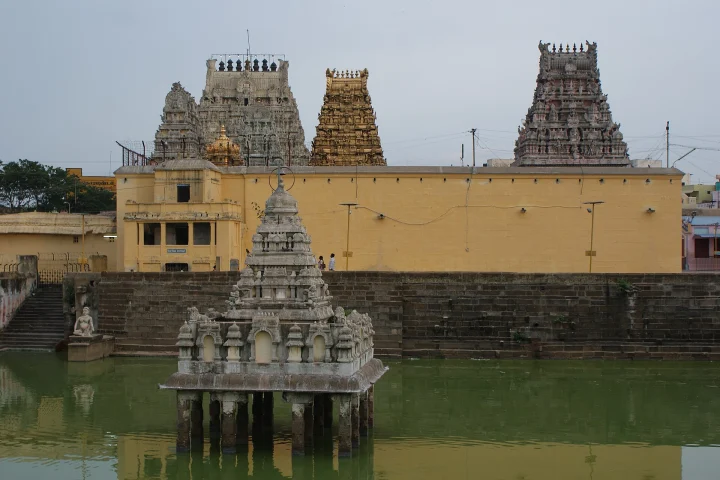
Kanchipuram is called a city of a thousand temples, and the Ekambareswarar Temple is the largest of them. It is one of the five Pancha Bhoota Sthalams and represents earth (Prithvi): the lingam here is regarded as a Prithvi Lingam, traditionally said to have been shaped from sand.
The temple covers about 9–10 hectares, so give yourself time. Here is what to expect, how to plan darshan, and how we reach it from Trichy and Pondicherry.
On this page
Deity and legend
Shiva is worshipped as Ekambareswarar – often explained as ‘Lord of the mango tree’ – and the Goddess as Elavarkuzhali. According to tradition, Parvati did penance under a mango tree on the bank of the Vegavati river and worshipped a lingam she made of sand. When the river flooded and threatened to wash it away, she held the lingam in a tight embrace to protect it, and Shiva appeared and married her. Because of this embrace he is also called Tazhuva Kuzhainthaar in Tamil, ‘he who melted in her embrace’.
The temple is a Paadal Petra Sthalam praised in the Tevaram. Inside the complex is also a small Vishnu shrine, Nilathingal Thundam Perumal, which is one of the 108 Divya Desams – a rare case of a Divya Desam within a Shiva temple.
Architecture highlights
Worship here is very old – Tamil literature refers to it well before the present buildings. The masonry temple was rebuilt in the Chola period and enlarged by the Vijayanagara rulers. Highlights:
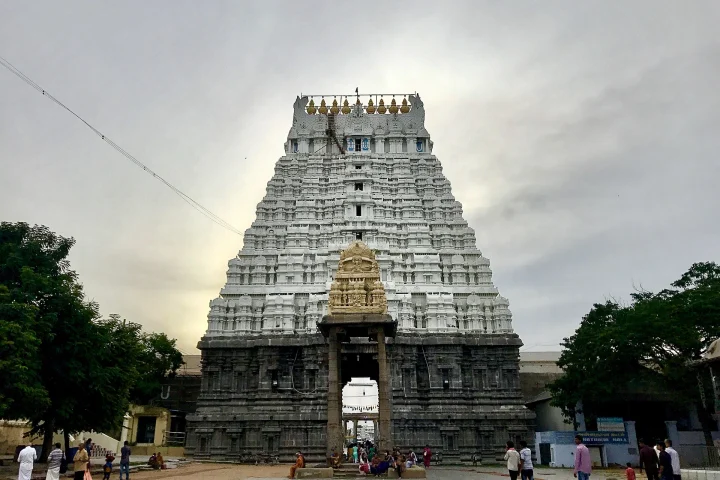
- The south Rajagopuram – 11 tiers and close to 59 m tall, attributed to Krishnadevaraya; one of the tallest temple towers in India.
- The sacred mango tree in the inner courtyard behind the sanctum – pilgrims pray beneath it, and it is linked to the marriage legend.
- The thousand-pillared hall of the Vijayanagara period.
- Rows of lingams along the corridors (the Sahasra Lingam and the 1,008-lingam walls).
Darshan tips
- Go early: tour buses arrive by mid-morning, and Kanchipuram’s main temples all close around midday.
- The walk from the gopuram to the sanctum is long; leave footwear at the official stand near the entrance.
- Walk to the mango tree after darshan and visit Nilathingal Thundam Perumal if you are collecting Divya Desams.
- Many families do Ekambareswarar and Kamakshi Amman together, since the two are linked in legend and are only a short drive apart.
Festivals
The 13-day Panguni Uthiram festival in March–April is the most important event in the temple and the town, when the divine marriage of Shiva and Parvati is celebrated with processions on the four car streets. Maha Shivaratri and Karthigai Deepam are also very busy. See the festivals calendar for months.
A suggested plan for a Kanchipuram day
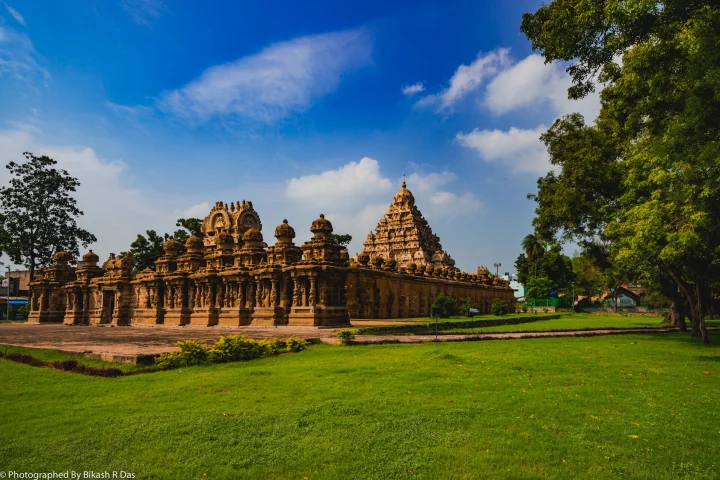
All the main temples of Kanchipuram follow a similar rhythm – open from early morning, closed for a few hours after midday, open again from late afternoon into the evening. A practical order is to start at Ekambareswarar soon after it opens, walk or drive the short distance to Kamakshi Amman, and finish the morning at Varadharaja Perumal in the eastern part of town. Spend the hot afternoon over lunch or in the silk-weaving streets, and visit Kailasanathar in the softer evening light.
From Pondicherry this is a comfortable long day trip if you leave by 5:30–6 am. From Trichy we suggest arriving the evening before and staying in Kanchipuram, so that you are at the first temple when the doors open.
Practical notes
- The temple floors are wide and open to the sun; mornings are much kinder to bare feet.
- There are simple vegetarian restaurants and tiffin shops around the temple streets.
- Elders can be dropped close to the gopuram by car; the walk inside the complex is long but flat.
- Keep small change for footwear stands, archanai tickets and offerings.
How to reach
From Pondicherry: about 120 km, roughly 2 hours 30 minutes to 3 hours by road via Tindivanam.
From Trichy: about 270 km, around 5 hours by road on the Chennai highway, turning off near Tindivanam or Chengalpattu. Most guests from Trichy stay a night in Kanchipuram.
Kanchipuram has its own railway station. The nearest airport is Chennai, about 65 km away. See our Kanchipuram town guide for stays and food.
Combine it with
- Kamakshi Amman Temple, Varadharaja Perumal Temple and Kailasanathar Temple – all in a single Kanchipuram temples day tour.
- Tiruvannamalai (fire) and Srikalahasti (air) on the Pancha Bhoota Sthalam tour.
- Tiruttani Murugan Temple, about 40 km to the north.
Frequently asked questions
Which element does Ekambareswarar represent?
Earth (Prithvi). The lingam is worshipped as the Prithvi Lingam, one of the five Pancha Bhoota Sthalams.
Is the mango tree still there?
A sacred mango tree stands in the inner courtyard behind the main shrine, and pilgrims pray beneath it. According to tradition it is where Parvati performed her penance.
Can I visit all the main Kanchipuram temples in one day?
Yes. Ekambareswarar, Kamakshi Amman, Varadharaja Perumal and Kailasanathar fit into one day if you start early and use the morning and evening opening hours.
Is there a Divya Desam inside Ekambareswarar Temple?
Yes. The small shrine of Nilathingal Thundam Perumal inside the complex is one of the 108 Divya Desams of Vishnu.