Last updated:
Deep in the Nallamala hills of Nandyal district, Ahobilam is the great centre of worship of Lord Narasimha, the man-lion form of Vishnu. It is not one temple but a sacred landscape: nine Narasimha shrines scattered over forested slopes and gorges, and the Prahladavarada temple in the village of Lower Ahobilam.
Ahobilam is praised by Thirumangai Alvar and counted among the 108 Divya Desams. It is also closely linked with the Sri Ahobila Matha, whose presiding deity is the processional image of Malola Narasimha. For many Sri Vaishnava families it is a once-in-a-lifetime pilgrimage – and a physical one.
On this page
The legend
According to tradition, this is where Narasimha burst out of a pillar to protect the boy-devotee Prahlada and destroyed the demon king Hiranyakashipu. A tall split rock on the ridge, the Ugra Stambham, is believed to be that pillar. The name is explained by a popular story: the gods, seeing the Lord’s strength, cried out “Aho balam!” – “what strength!” – and the place became Ahobalam, or Ahobilam.
The Lord is also associated here with Chenchu Lakshmi, a form of the Goddess linked with the Chenchu forest people of these hills, and that bond is celebrated in the Paruveta festival each year.
The nine shrines – and how hard each one is
Please read this before you plan. Distances below are approximate and paths change with the season.
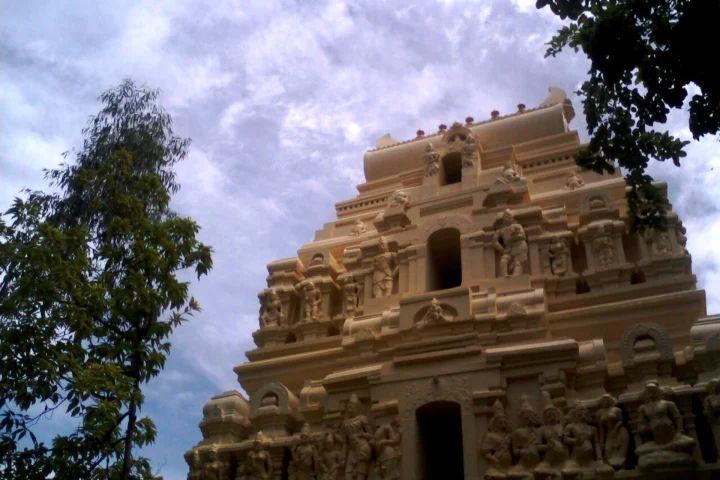
- Prahladavarada (Lower Ahobilam) – the main temple in the village, mostly of the sixteenth century, with fine Vijayanagara mandapas. By car, no climbing.
- Yogananda and Chatravata Narasimha – a short drive from Lower Ahobilam, easy to reach.
- Karanja Narasimha – beside the road up to Upper Ahobilam. Easy.
- Ahobila (Ugra) Narasimha – the main shrine of Upper Ahobilam, about 8 km above the village by road, in a cave-like sanctum. Easy, with some steps.
- Kroda (Varaha) Narasimha – a walk of about a kilometre up the stream from Upper Ahobilam, over rocks and steps. Moderate.
- Malola Narasimha – a climb of about two kilometres with steps from Upper Ahobilam. Moderate to steep.
- Jwala Narasimha – the hardest of the regular walks: a steep rocky path of several kilometres from Upper Ahobilam, with steps, boulders and a stretch past a waterfall. Tradition places the slaying of Hiranyakashipu here. The Ugra Stambham lies further up and is only for fit, experienced walkers.
- Bhargava Narasimha – near Lower Ahobilam but reached by a rough track and a flight of steps; many pilgrims use a local jeep for the track.
- Pavana Narasimha – the most remote shrine, deep in the forest. Most pilgrims hire a local jeep for a long, very bumpy dirt-track ride; walking it is a full-day forest trek.
Honest advice for the treks
- Start early – around dawn – from Upper Ahobilam. Food and water are scarce beyond the base, so carry your own.
- For Jwala and the Ugra Stambham, and for Pavana by foot, take a local guide. Paths are not always marked.
- The jeep ride to Pavana Narasimha is rough. It is not advisable for pregnant women or people with back or spine problems.
- Elderly pilgrims can still have a fulfilling visit: Prahladavarada, Yogananda, Chatravata, Karanja and Upper Ahobilam can all be seen without a hard climb.
- Monkeys are common near Upper Ahobilam; keep food and bags closed.
A suggested plan
We usually allow two nights at or near Ahobilam. On the first day, after arriving, have darshan at Prahladavarada in Lower Ahobilam and, if time allows, Yogananda and Chatravata Narasimha. On the second day, drive up early to Upper Ahobilam for Ahobila, Kroda, Malola and – for those who are able – Jwala Narasimha, then come down for Karanja. The jeep ride to Pavana and Bhargava Narasimha can take the morning of a third day.
How to reach
From Pondicherry: about 445 km by road via Tirupati and Kadapa, roughly 9–10 hours of driving.
From Trichy: about 565 km, around 11–12 hours – best split over two days.
Many pilgrims take a train or flight to Kurnool (about 140 km, 3 hours by road) and use our car from there. Nandyal (about 70 km) is a convenient railhead; Kadapa (about 100 km) and Kurnool have airports.
Stays in Ahobilam itself are simple. See our Ahobilam town guide for where to stay and what else is nearby.
Combine it with
- Mahanandi, the Shiva temple with spring-fed pools, about 65 km away.
- Mantralayam and Alampur Jogulamba to the west.
- Other great Narasimha shrines: Mangalagiri and Yadadri.
- Our Mantralayam and Ahobilam tour from Pondicherry allows two days here.
Before you go
Pack walking shoes, a rain cover in the wet months, a torch, water and light snacks. Tell us honestly about the fitness of your group – contact us and we will plan which shrines to cover on each day.
Frequently asked questions
Can all nine Ahobilam temples be seen in one day?
Very fit pilgrims sometimes manage it, but two days is more realistic. Most families do the Upper Ahobilam shrines on one day and Pavana and Bhargava Narasimha by jeep on another.
Which Ahobilam shrines need a trek?
Kroda and Malola need moderate walks, Jwala Narasimha and the Ugra Stambham need a steep climb, and Pavana Narasimha needs a long jeep ride or a full-day trek. The others can be reached by road or with a few steps.
Is Ahobilam suitable for elderly people?
Yes, for the shrines near the road – Prahladavarada, Yogananda, Chatravata, Karanja and the main Upper Ahobilam shrine. The forest climbs and the Pavana jeep ride are hard on older people.
Is Ahobilam a Divya Desam?
Yes. It was praised by Thirumangai Alvar and is counted among the 108 Divya Desams.
How far is Ahobilam from Pondicherry?
About 445 km by road, roughly 9–10 hours of driving via Tirupati and Kadapa.