Last updated:
Away from the crowds of central Kanchipuram, on the western edge of town, stands the Kailasanathar Temple – the oldest surviving structural temple in the city and one of the finest Pallava buildings anywhere. It was built around 700 CE by the Pallava king Narasimhavarman II, known as Rajasimha, and his son Mahendravarman III completed the front part.
It is small compared with the giant Chola and Nayak temples, but every wall is covered in sculpture. For many pilgrims it is the quiet, reflective stop of a Kanchipuram day.
On this page
Deity and history
The sanctum holds a 16-sided black granite lingam worshipped as Kailasanathar, ‘Lord of Kailasa’. Behind it, on the rear wall, is a carved Somaskanda panel – Shiva with Parvati and the child Skanda – a favourite Pallava theme.
Before this temple, Pallava shrines were mostly cut into rock, as at Mahabalipuram. Kailasanathar is one of the earliest examples in South India of a temple built of dressed stone, and it influenced later temple building in the region. Today it is maintained by the Archaeological Survey of India, and daily worship continues.
Architecture highlights
- Sandstone walls on a granite base, with a pyramidal vimana rising over the sanctum.
- 58 small shrines built into the inner face of the enclosure wall, each with a carved image of Shiva or the Goddess.
- Rearing lions (yali) on the pillars – a hallmark of Pallava style.
- Traces of very early mural paintings in some of the cell shrines.
- A narrow passage around the sanctum that devotees traditionally crawl through and come out of, believed to symbolise rebirth.
Darshan and visiting tips
- It is usually peaceful, so take your time to walk the inner circuit slowly.
- The soft sandstone is fragile – please do not touch, lean on or climb the sculptures.
- The temple has neat lawns around it; come early in the morning for soft light and cool stone.
- Combine with Kanchipuram’s busier temples, which all close around midday – Kailasanathar works well as the first or last stop.
Festivals
Maha Shivaratri is the main festival, when devotees fill the temple in the evening for night-long worship. On most other days the temple is calm.
Why this temple matters
Kailasanathar is a rare chance to see a Pallava temple much as its builders intended. Most of the great temples of Tamil Nadu were enlarged again and again over the centuries, with new walls, halls and towers; here the core layout of the early 8th century survives clearly – the sanctum with its pyramidal tower, the enclosure wall lined with small shrines, and a modest entrance gateway. Inscriptions on the temple record the names and titles of the Pallava king who built it.
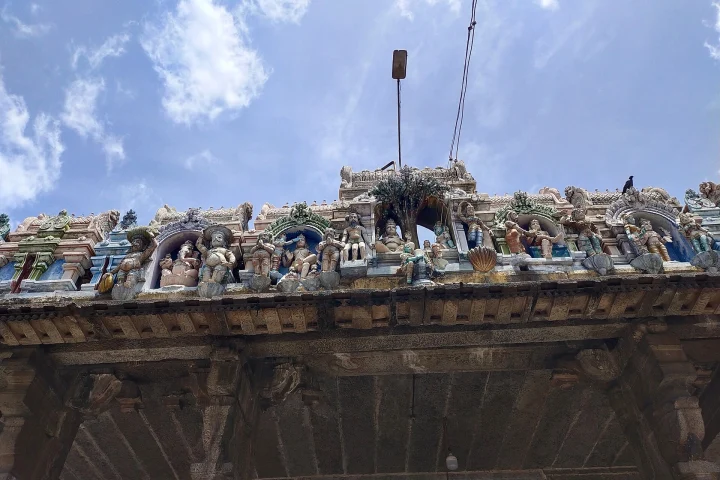
The carvings show Shiva in many forms – as the cosmic dancer, as the destroyer of demons, as the teacher Dakshinamurthy, and with Parvati – alongside images of Vishnu, Durga and other deities. Many sculptures are worn by time and partly restored, so look closely and slowly.
A suggested plan
Because Kailasanathar is quieter and has softer stone that glows in low sun, we usually keep it for the evening of a Kanchipuram day, after Ekambareswarar, Kamakshi Amman and Varadharaja Perumal in the morning. Photographers and history lovers may prefer the early morning instead. From Pondicherry, all of Kanchipuram fits into one long day; from Trichy we suggest an overnight stay.
If you are travelling with children, this is a good temple to explain stories through the sculptures – each small shrine on the inner wall is like a page from an old picture book.
Temple etiquette at a protected monument
Because Kailasanathar is both a living temple and a protected monument, a little extra care goes a long way. Walk barefoot only on the paved paths, keep children from climbing on the plinths and lion pillars, and do not light camphor or apply kumkum on the carved walls – offerings are made only at the sanctum. Speak softly inside the enclosure; the quiet is part of what makes this temple special.
How to reach
From Pondicherry: about 120 km, roughly 2 hours 30 minutes to 3 hours by road.
From Trichy: about 270 km, around 5 hours by road.
The temple is about 2 km west of Kanchipuram bus stand. Kanchipuram railway station is nearby and Chennai airport is about 65 km away.
Combine it with
- The Kanchipuram temples day tour with Ekambareswarar, Kamakshi Amman and Varadharaja Perumal.
- If you love temple architecture, the Great Chola Temples of Thanjavur, Gangaikonda Cholapuram and Darasuram show how the style grew in later centuries.
- Tiruvannamalai, about 2 hours away.
Frequently asked questions
Who built the Kailasanathar Temple in Kanchipuram?
The Pallava king Narasimhavarman II (Rajasimha) built it around 700 CE; his son Mahendravarman III completed the front part.
Is worship still performed here?
Yes. Although the temple is a protected monument maintained by the Archaeological Survey of India, daily worship continues and Maha Shivaratri is celebrated.
Is there an entry fee?
No, entry is free at the time of writing.
How much time do I need?
About 45 minutes to an hour is enough to see the shrines and the carvings at a relaxed pace.