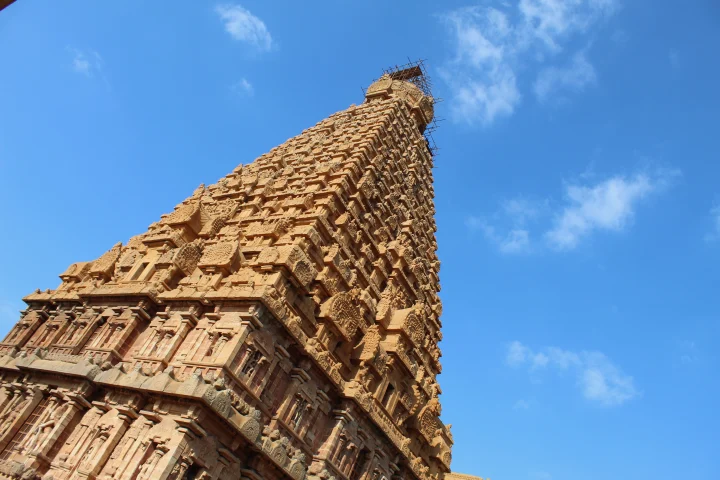
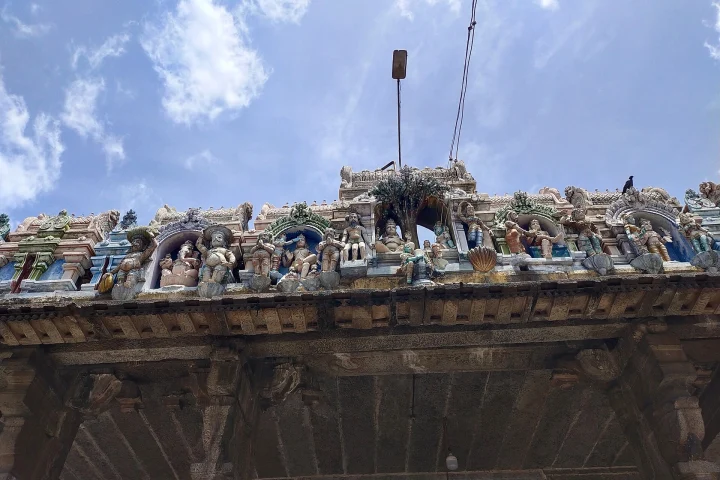
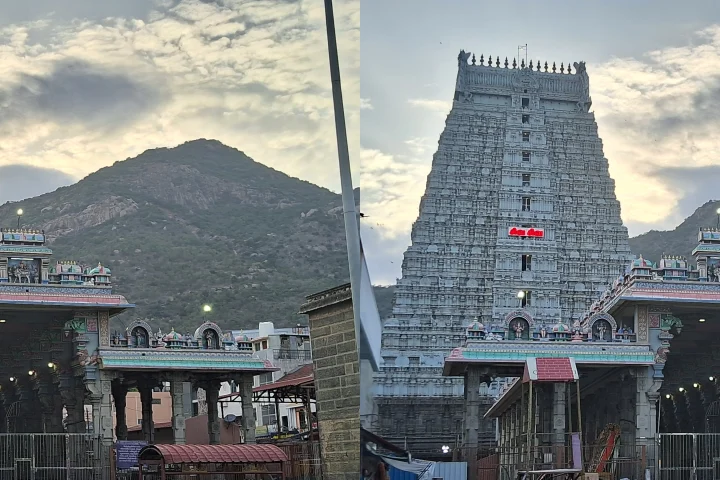
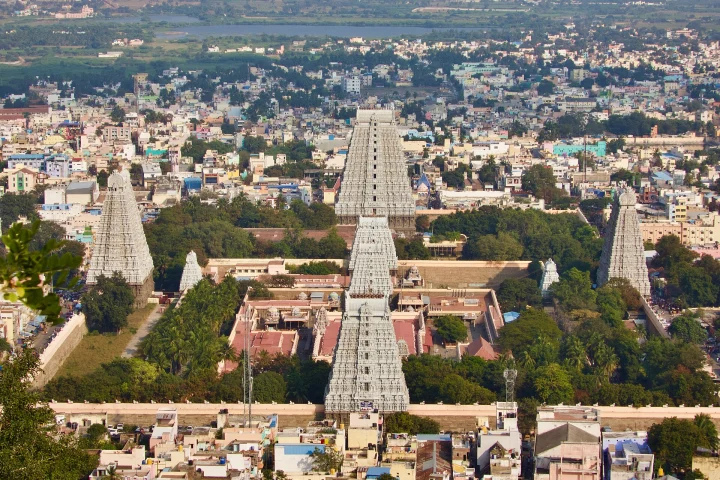
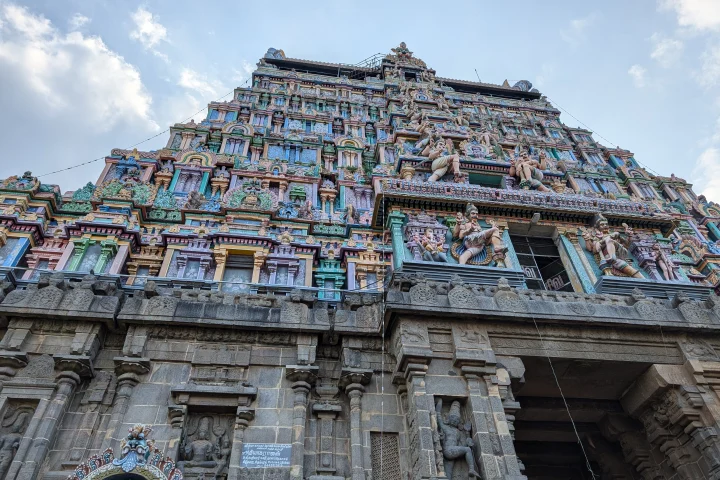
Girivalam – “going around the hill” – is the walk that devotees make around the sacred hill of Arunachala at Tiruvannamalai. For Shiva devotees, Arunachala is not just a hill where God lives; according to tradition it is Shiva himself, in the form of a mountain of fire. Walking around it slowly, in prayer, is a way of circling the Lord – the same pradakshina devotees make around a temple sanctum, on a grand scale.
People walk every day of the year, but on full-moon (Pournami) nights the road fills with pilgrims from across Tamil Nadu and beyond. This guide explains how the walk works and how to make the most of it.
On this page
The route
The Girivalam path is about 14 km long. It runs around the base of Arunachala on a paved road, with a separate footpath along much of the route. Most pilgrims start and end at the Arunachaleswarar Temple in town, often after darshan, though you can start anywhere on the circuit as long as you return to the same point.
Walk clockwise, keeping the hill on your right – the same direction as a pradakshina inside a temple. At an easy pace, with stops at the shrines, the walk takes about four to five hours; brisk walkers finish in about three.
The eight Ashta Lingams
Eight small Shiva shrines stand around the path, each associated with one of the eight directions and its guardian deity. In order around the hill, they are:
- Indra Lingam (east)
- Agni Lingam (south-east)
- Yama Lingam (south)
- Niruthi Lingam (south-west)
- Varuna Lingam (west)
- Vayu Lingam (north-west)
- Kubera Lingam (north)
- Esanya Lingam (north-east)
Other places on the path
- Sri Ramana Ashram, where the sage Ramana Maharshi lived, near the start of the path on the southern side of the hill.
- Seshadri Swamigal Ashram, close to Ramana Ashram.
- Adi Annamalai Temple, an old Shiva temple on the far side of the hill from the town.
- Many small shrines, tanks and mandapams where walkers rest and pray.
- The Skandashram path, which climbs a short way up the hill from near the temple – a separate walk, best done in the cool of the morning.
When to go
Pournami nights
Full-moon nights are the most popular. Each month the temple administration announces the auspicious start and end times of the Pournami, and the walk is traditionally done within that period. The crowd is huge but good-natured, with chanting, music and stalls along the way. Expect traffic restrictions on the Girivalam road and around the town.
Big festival nights
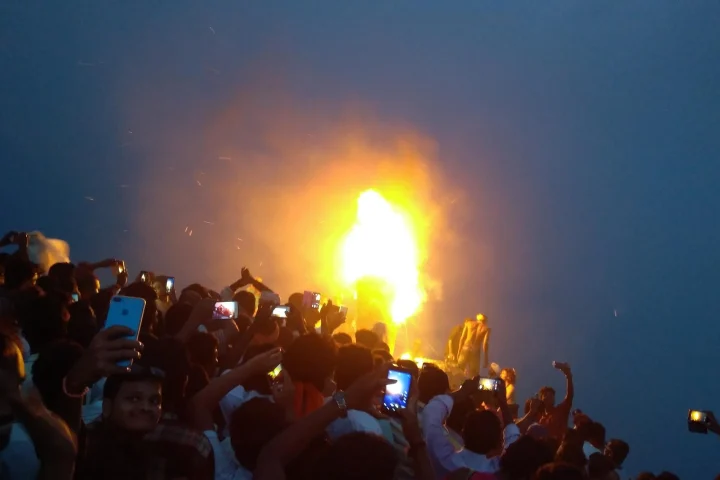
The largest crowds come on Chitra Pournami (Chithirai, April–May) and during the Karthigai Deepam festival (Karthigai, November–December), when a great flame is lit on the summit of the hill. These nights are unforgettable but very crowded; book your room months ahead. See our festivals calendar.
Quiet days
If you prefer peace, walk on an ordinary morning, starting at dawn. The path is calm, the hill is clear in the early light, and you will finish before the heat. Many long-time devotees prefer this.
Barefoot or not?
Many pilgrims walk barefoot as an act of devotion and humility. It is a personal choice, not a rule. If you are not used to walking barefoot, 14 km on tar can cause blisters, especially on a warm afternoon; walk at night or early morning, or wear simple sandals. Elders with diabetes or foot problems should not walk barefoot.
What to carry
- A water bottle – there are water stalls, but carry your own
- A small snack and any medicines you need
- A light shawl for the cool hours after midnight in winter
- A small torch or a basic phone with a light
- Little cash; leave valuables at the hotel
- Comfortable, modest clothes – see our dress code guide
Safety and comfort
- On Pournami nights the road is lit and busy, and police and volunteers are on duty. Walk in a group and agree on a meeting point in case you get separated.
- Keep to the footpath; vehicles still use parts of the road on ordinary days.
- Rest when you need to – there are many mandapams and tea stalls.
- If someone cannot continue, our driver can meet you at a point on the road (outside the restricted hours).
Temple darshan
The Arunachaleswarar Temple, one of the Pancha Bhoota Sthalams representing fire, is one of the largest temple complexes in India, with Goddess Unnamulai Amman in her own shrine. Many pilgrims take darshan before starting the walk. On Pournami, queues can be very long; going in the late afternoon when the temple reopens usually helps. Temple timings vary on festival and Pournami days – check before you go. Read more in Pancha Bhoota Sthalams explained.
Getting to Tiruvannamalai
Our Tiruvannamalai Girivalam trip from Pondicherry includes a hotel night so you can rest after the walk. You can also combine Tiruvannamalai with Kanchipuram and Chidambaram on the Pancha Bhoota Sthalam tour.
- From Pondicherry: about 110 km by road, around 2.5 to 3 hours via Villupuram or Gingee.
- From Trichy: about 180 km, around 4 hours.
- Tiruvannamalai has a railway station; the nearest airports are Chennai and Pondicherry (limited flights).
A suggested Pournami evening
- Afternoon: arrive in Tiruvannamalai, check in and rest.
- About 4 pm: darshan at the Arunachaleswarar Temple when it reopens; expect a queue.
- Early evening: light dinner, and leave bags and valuables at the hotel.
- After moonrise, within the announced Pournami period: start the walk from the temple, heading clockwise.
- Late night: finish back at the temple, then return to the hotel to rest.
- Next morning: a quiet visit to Sri Ramana Ashram before the drive home.
Ramana Maharshi and Arunachala
Many visitors from India and abroad know Tiruvannamalai through Sri Ramana Maharshi, the sage who came to the town as a young man in 1896 and lived there, on and around the hill, for the rest of his life until 1950. He spoke of Arunachala with deep devotion and often walked around it with his devotees. Sri Ramana Ashram, at the foot of the hill, welcomes visitors and is a peaceful place to sit after the walk.
Book with us
Call or WhatsApp +91 96265 65138 (24 hours) or use our contact page with the Pournami date you have in mind.
Frequently asked questions
How long is the Girivalam path?
About 14 km around the base of Arunachala hill.
Which direction should we walk?
Clockwise, keeping the hill on your right-hand side.
Do we have to walk barefoot?
No. Many pilgrims walk barefoot as a mark of devotion, but it is a personal choice. Wear sandals if you are not used to it or have foot problems.
Can we do Girivalam on a day that is not Pournami?
Yes. You can walk any day; ordinary mornings are much quieter than full-moon nights.
Where can we find the Pournami timings?
The temple announces the auspicious start and end times each month, and they are published in the Tamil press. We can also confirm them for you.