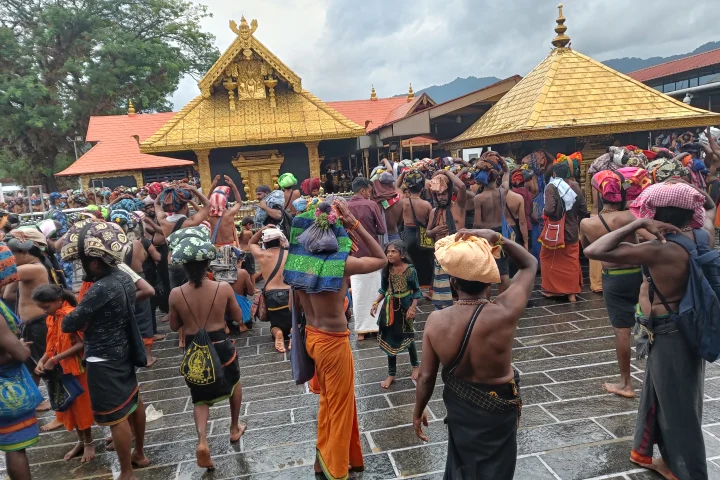
Every winter, devotees from across South India set out for Sabarimala wearing black, chanting “Swamiye Saranam Ayyappa” and carrying the irumudi on their heads. For many families in Tamil Nadu it is a yearly vow. Yet the yatra has its own rules, its own calendar and, today, its own booking system, and first-timers often feel unsure where to begin.
This guide puts the essentials in one place, from the vratham at home to the moment you climb the eighteen steps. When you are ready to travel, see our Sabarimala yatra by car from Trichy or Pondicherry.
On this page
The temple and its Lord
The Sabarimala Ayyappa Temple stands on a hilltop in the forests of Pathanamthitta district, Kerala, inside the Periyar Tiger Reserve. Lord Ayyappa, also called Dharma Sastha, is worshipped here in a seated yogic posture. According to tradition, Ayyappa was born of Shiva and Mohini (Vishnu’s enchanting form), was raised by the Pandalam royal family, and chose to remain at Sabarimala as a celibate yogi.
The temple is administered by the Travancore Devaswom Board (TDB). It is known for welcoming pilgrims of every caste and background, and on the way devotees honour Vavar, a Muslim companion of Ayyappa in the local tradition, at Erumeli and at the Sannidhanam.
When Sabarimala is open
Unlike most temples, Sabarimala is not open all year. The main pilgrimage is the Mandala–Makaravilakku season:
- The temple opens in mid-November, on the eve of the first day of the Malayalam month of Vrischikam.
- The 41-day Mandala period ends with the Mandala Pooja in late December, after which the temple closes for a few days.
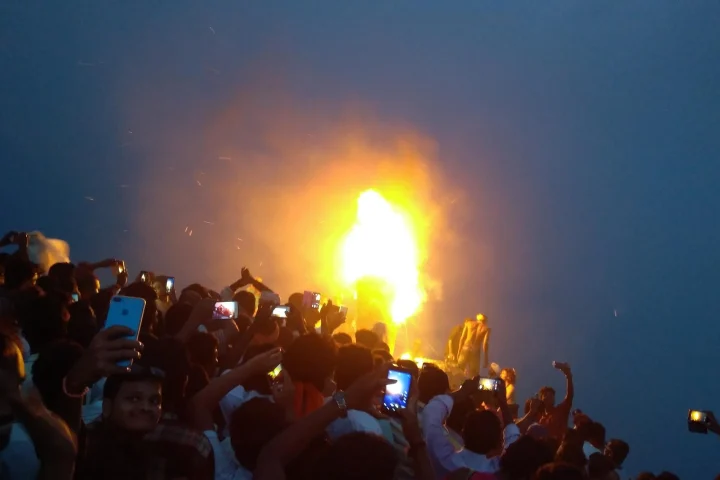
- It reopens at the end of December for the Makaravilakku festival, held on Makara Sankranti in mid-January, and closes a few days later.
- For the 2026–27 season, the temple opened on 16 November 2026; the Mandala Pooja is on 27 December 2026 and Makaravilakku on 14 January 2027, at the time of writing.
- Outside the season it opens for the first few days of every Malayalam month and for Vishu in April. The TDB announces all dates – check before you go.
The 41-day vratham
Traditionally the pilgrimage begins weeks before the journey. The devotee wears a mala of tulasi or rudraksha beads, given by a guru swami or at a temple, and keeps a 41-day vratham (discipline). From that day everyone in the group calls each other “Swami”.
- A vegetarian diet, and no alcohol, tobacco or other intoxicants.
- Celibacy and a calm, simple life; no harsh words or quarrels.
- Simple clothes in black, blue or saffron, and usually no shaving or haircuts.
- Daily bath and prayer, often with bhajans in the evening.
- Sleeping on a mat and avoiding luxuries, as far as you can.
The irumudi
Before leaving, the group gathers for the kettu nirai, the filling of the irumudi. The irumudi is a two-part cloth bundle. The front part carries the offerings for the Lord, above all a coconut filled with ghee for the neyyabhishekam; the back part carries simple provisions for the journey. Only pilgrims carrying the irumudi climb the eighteen holy steps, the Pathinettampadi. Those without it reach the shrine by a separate path. Your guru swami will tell you what your group traditionally puts in the bundle.
Booking: the virtual queue
During the season, darshan is managed through a virtual-queue system run by the Travancore Devaswom Board. Each pilgrim books a free time slot on the official portal, sabarimalaonline.org, using a photo ID, and carries the pass (printed or on the phone). At the time of writing, children under five do not need a pass.
Slots for the busiest days, such as weekends, the Mandala Pooja and the days around Makaravilakku, fill up quickly, so book as soon as you know your dates. A limited number of spot-booking passes are issued at centres such as Nilakkal, Erumeli and Vandiperiyar at the time of writing, but you should not plan your trip around them. Travel companies cannot book the queue on your behalf.
Reaching Pamba from Tamil Nadu
Most pilgrims from Tamil Nadu come by road. The usual route from Trichy runs via Dindigul, Theni and Kumily into Kerala, then via Erumeli to Nilakkal; it is about 360 km and 8 to 9 hours of driving. From Pondicherry add about 200 km. Groups from the south of Tamil Nadu often use the Tenkasi–Punalur route instead.
During the season, private vehicles are normally parked at Nilakkal, the base camp about 22 km before Pamba, and KSRTC buses shuttle pilgrims to Pamba. Rules on dropping pilgrims at Pamba change from year to year, so follow the police notices. If you travel by train, the nearest large stations are Chengannur and Kottayam; the nearest airports are Kochi and Thiruvananthapuram.
The climb and darshan
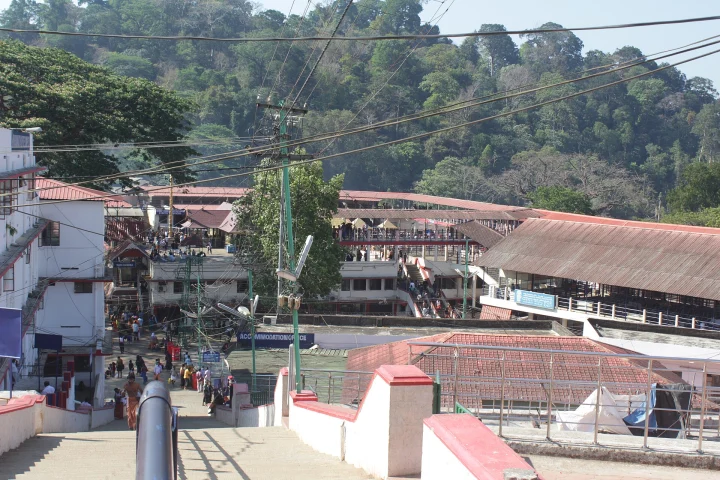
At Pamba, pilgrims bathe in the river and worship at the Pamba Ganapathi temple before starting. The traditional path to the Sannidhanam is about 5 km, paved and stepped, and steep in places, passing Neelimala, Appachimedu and Sabaripeedam; at Saramkuthi first-time pilgrims leave the arrows they carry. Most people take 3 to 4 hours with rests.
At the top, pilgrims with the irumudi climb the eighteen steps and have darshan. The ghee from the coconut is offered for the neyyabhishekam, which is performed in the morning hours, and part of it is taken home as prasadam along with aravana and appam. Most pilgrims also visit the shrine of Malikappurathamma nearby. Some groups also walk the long traditional forest route from Erumeli, or the path from Sathram near Vandiperiyar; these are opened in the season under forest department rules.
Women and the yatra
Traditionally, women aged roughly 10 to 50 do not undertake the Sabarimala pilgrimage; girls and older women often travel with their family groups. The question of women’s entry has been before the Supreme Court of India, which gave a judgment in 2018 and later referred related questions to a larger bench, and practice on the ground has changed over time. We do not take a position on the matter. Women planning to travel should check the Travancore Devaswom Board’s current rules before booking.
Health and safety tips
- If you have heart, breathing or knee problems, see your doctor before the trip, walk slowly and rest often. Medical aid centres are set up along the path during the season.
- Carry very little: the irumudi, a small bag, water, medicines and a torch. Avoid plastic.
- Wear comfortable footwear for the drive; most pilgrims walk the path barefoot or in simple sandals, as their group’s custom allows.
- Stay with your group in the crowd, and agree a meeting point in case you are separated.
- Keep your ID and virtual-queue pass with you at all times.
After Sabarimala
Many groups combine the yatra with other temples. Popular choices are Guruvayur, the South Kerala temples of Thiruvananthapuram, or Murugan at Palani on the way home. For Kerala temple customs, read our Kerala temple rules and dress code, and for the season as a whole see the best time for temple tours in South India.
Frequently asked questions
When does Sabarimala open for the Mandala season?
In mid-November, at the start of the Malayalam month of Vrischikam. For 2026–27 it opened on 16 November 2026, with the Mandala Pooja on 27 December and Makaravilakku on 14 January 2027, at the time of writing.
Is the virtual queue compulsory?
During the season, darshan is managed through the virtual queue on sabarimalaonline.org, with a limited number of spot-booking passes at a few centres. Book online in advance to be safe.
Do I have to keep the 41-day vratham?
The 41-day vratham is the tradition, and pilgrims who climb the eighteen steps with the irumudi are expected to keep it. Your guru swami will guide you on your group’s practice.
How long is the walk from Pamba to the temple?
About 5 km uphill on a paved and stepped path. Most pilgrims take 3 to 4 hours with rests; the walk down is quicker.
Can women visit Sabarimala?
Traditionally, women aged roughly 10 to 50 do not undertake the pilgrimage. The matter has been before the Supreme Court, so please check the Travancore Devaswom Board’s current rules.