Last updated:
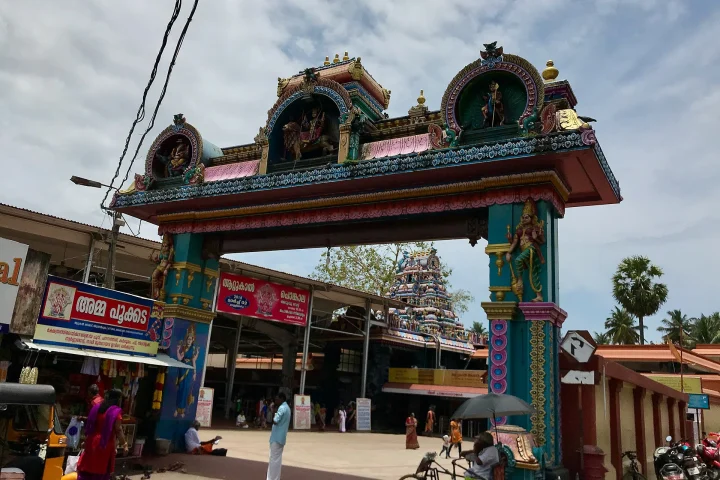
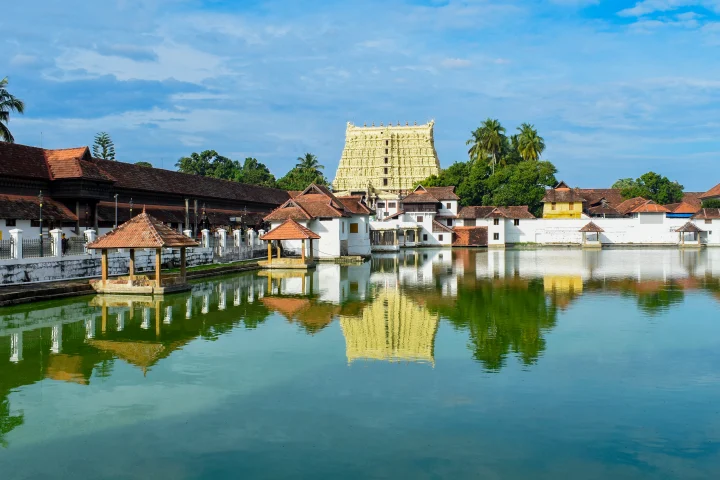
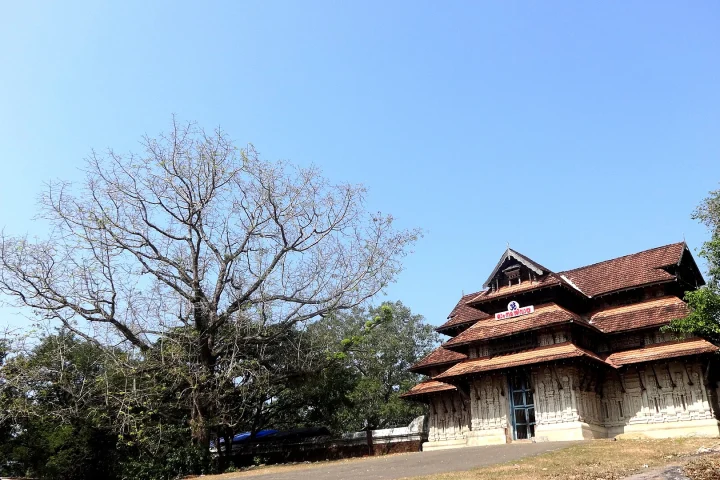
Thiruvananthapuram – ‘the city of Lord Anantha’ – takes its very name from its great temple. At its centre, in the old East Fort area, stands the Sree Padmanabhaswamy Temple, where Lord Vishnu reclines on the serpent Anantha. A few kilometres south is the Attukal Bhagavathy Temple, whose annual Pongala fills the city’s streets with women devotees cooking offerings over open fires.
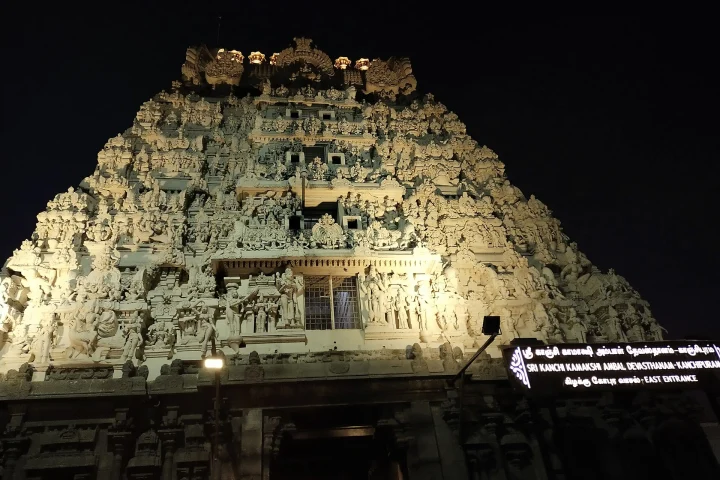
For pilgrims coming from Tamil Nadu, the city is the natural end point of a southern journey: Kanyakumari is about 90 km away, and the road passes through Nagercoil and the old Travancore country.
On this page
Main temples
Sree Padmanabhaswamy Temple
The presiding deity is Lord Padmanabha, Vishnu in yoga nidra on the serpent Anantha, with Brahma on the lotus rising from his navel. The image is so large that it is seen through three doors: the face and hand, the navel and lotus, and the feet. The temple is one of the 108 Divya Desams, praised by Nammalvar. The rulers of Travancore dedicated their kingdom to the deity and ruled as Padmanabha Dasa, the Lord’s servants, and the royal family still has a role in the temple’s rituals. See the Padmanabhaswamy Temple page.
Attukal Bhagavathy Temple
On the bank of the Killi river, about 2–3 km from the East Fort, Attukal is a temple of the Mother Goddess, identified by devotees with Kannaki, the heroine of the Tamil epic Silappathikaram. It is best known for the Attukal Pongala, held in the Malayalam month of Kumbham (February–March), when vast numbers of women prepare pongala in clay pots along the roads around the temple. See the Attukal Bhagavathy Temple.
History and legend in brief
The Padmanabhaswamy Temple is ancient, and the present structure owes much to the 18th-century Travancore king Marthanda Varma, who rebuilt it and, according to tradition, dedicated his kingdom to the Lord in 1750. The temple was again in the news in 2011, when inventories of its vaults were ordered by the Supreme Court of India. Today it is run under arrangements set by the Supreme Court, with the royal family continuing in its traditional role.
Several legends explain the deity’s origin; a well-known one tells of the sage Divakara Muni, who followed a mischievous child into the forest and saw him become the reclining Lord. As always, these are stories of faith, told differently by different families.
Dress code and entry rules
Padmanabhaswamy has one of the strictest dress codes in South India. In line with the temple’s rules, only Hindus may enter. Men wear a mundu (dhoti) and go bare-chested or with only an angavastram (upper cloth) over the shoulder; shirts and trousers are not allowed inside. Women wear a saree or traditional dress; mundus can usually be rented or bought near the gates to wear over other clothes. Mobile phones and cameras are not allowed and must be deposited at the counters outside. These rules are applied strictly – at the time of writing, check before you go.
See also our Kerala temple rules and dress code guide.
Darshan tips
- The temple opens before dawn and has several short darshan windows during the day, with a long closure in the afternoon; timings change for festivals, so check on the day.
- The early-morning darshan is the calmest; weekends and Kerala holidays bring long queues.
- Allow about 2 hours for darshan and a walk along the stone corridor.
- Attukal is busiest on Tuesdays, Fridays and during the Pongala festival.
- The temple area has narrow streets; our driver will drop you near the gates and wait at a parking area.
Festivals
- Alpasi Utsavam (October–November) and Painkuni Utsavam (March–April) at Padmanabhaswamy, each ending with the Aarattu procession to the sea at Shanghumugham.
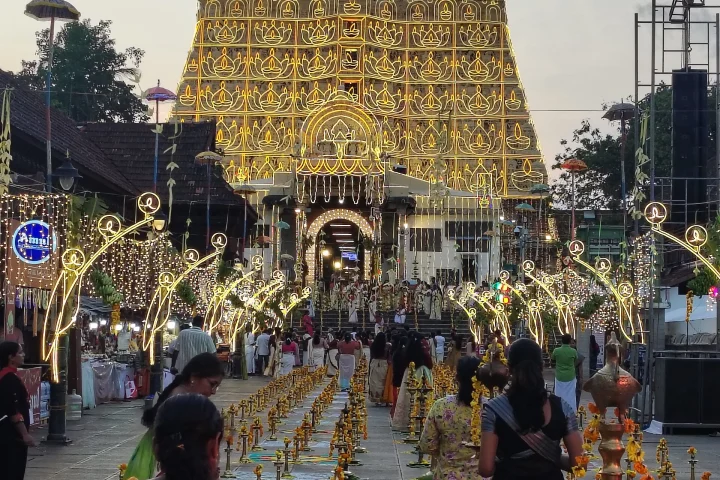
- Lakshadeepam, held once every six years at Padmanabhaswamy, when the temple is lit with thousands of lamps.
- Attukal Pongala, in the Malayalam month of Kumbham (February–March).
- Navaratri (September–October), a major festival across the city.
Where to stay
Hotels near the East Fort and Thampanoor (by the central railway station and bus stand) are within walking distance of the temple – ideal for early darshan. Kovalam beach, about 15 km away, has resort stays if you want a quieter base. We book a hotel of your choice on request.
Best time to visit
October to March brings the most comfortable weather. The south-west monsoon (June–September) is heavy but temples stay open; the rain gives Kerala its green beauty, though travel can be slower. Festival periods are crowded; book rooms early for Attukal Pongala.
How to reach
From Trichy: about 435 km, 8–9 hours via Madurai, Tirunelveli and Nagercoil. Many pilgrims stop at Kanyakumari on the way.
From Pondicherry: about 650 km, 12–13 hours. Break the journey at Trichy or Madurai, or take a train or flight and use our car from Thiruvananthapuram.
Thiruvananthapuram Central railway station is about 1 km from the temple, and the international airport is close to the city. See our South Kerala temples tour or book a car with driver.
Frequently asked questions
Can non-Hindus enter the Padmanabhaswamy Temple?
According to the temple’s rules, only Hindus may enter. Visitors may be asked to confirm this at the entrance.
What is the dress code at Padmanabhaswamy Temple?
Men wear a mundu (dhoti) and no shirt, with an optional upper cloth; women wear a saree or traditional dress. Mundus can usually be hired near the gates. Phones and cameras are not allowed.
How far is Kanyakumari from Thiruvananthapuram?
About 90 km, around 2–2½ hours by road.
When is the Attukal Pongala?
In the Malayalam month of Kumbham, usually February or March. The exact date is announced by the temple every year.