Last updated:
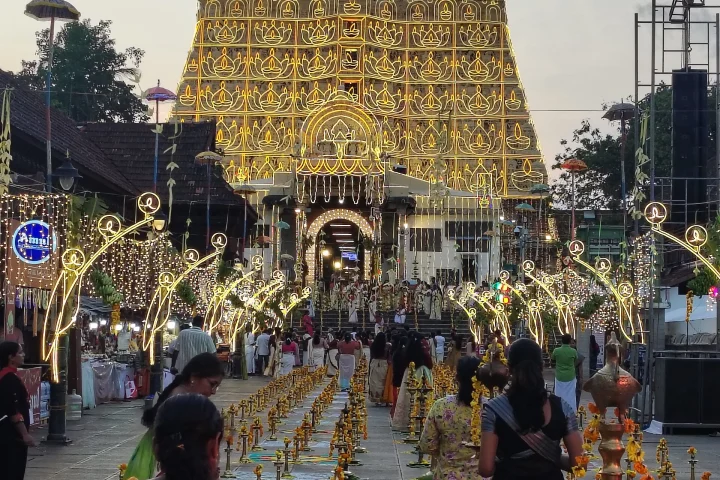
A short drive south of the East Fort in Thiruvananthapuram, the Attukal Bhagavathy Temple is the city’s best-loved goddess temple. Devotees call the deity Attukalamma – Mother of Attukal – and many families visit her as naturally as they would visit an elder at home.
The temple is known across the world for the Attukal Pongala, when women from every background cook sweet rice offerings in earthen pots along the streets around the shrine. Guinness World Records has recognised it as one of the largest gatherings of women for a religious festival.
On this page
The goddess and her legend
The goddess is worshipped as Bhadrakali, the fierce yet protective form of the Mother Goddess, and is often described as embodying all three great goddesses. Local tradition also links her with Kannaki, the faithful wife whose story is told in the Tamil epic Silappathikaram. After Madurai was destroyed by her anger, it is said, she travelled south and rested at Attukal.
Another family tradition tells of an elder of the Mulluveettil family who helped a radiant young girl cross the Killi river. She vanished, then appeared to him in a dream and showed him the place in a sacred grove where she wished to be worshipped – the spot where the shrine stands today. During the festival, the story of Kannaki (Kannaki Charitam) is sung for nine days, linking Attukal with the Kodungallur Bhagavathy temple further north.
Attukal Pongala
The ten-day festival begins with the Kappukettu ceremony on the Karthika star in the Malayalam month of Makaram–Kumbham (February–March). The main Pongala falls on the ninth day, on the Pooram star, which coincides with the full moon.
At an auspicious moment the chief priest lights the hearth inside the temple, and the flame is passed from hearth to hearth along kilometres of road. Women cook pongala – rice with jaggery, coconut and plantain – and offer it to the goddess. Priests later sprinkle holy water over the offerings. At the time of writing, the 2027 festival is scheduled for 14–23 February, with the Pongala on 22 February; confirm the dates before you plan.
- Participants usually reserve a spot on the roadside a day or more in advance.
- Bring your own pot, rice, jaggery and firewood, or buy them from the stalls that appear near the temple.
- Traffic is heavily restricted on Pongala day; walk the last stretch and plan your return accordingly.
- Families who are only watching should stay back from the hearths and keep children close.
Darshan tips on a normal day
- Mornings soon after opening and evenings after 5 pm are the calmest times.
- Tuesdays and Fridays are popular goddess days and draw more devotees.
- Carry flowers, ghee or oil for the lamp if you wish; offerings and vazhipadu are booked at the temple counters.
- Remove footwear at the stands outside, and keep a small cloth or towel with you.
- If you are combining temples, visit Padmanabhaswamy Temple first – its sessions are shorter and stricter – and come to Attukal afterwards.
What to wear
Attukal is less formal than Padmanabhaswamy, but modest traditional clothes are expected. Men are comfortable in a dhoti or trousers with a shirt and should follow any notice to remove the shirt near the shrine. Women usually wear a saree, churidar or long skirt. Our Kerala temple rules and dress code guide explains the customs across the state.
Other festivals
Beyond Pongala, the temple celebrates Navaratri with Pooja Veppu, when books and tools are placed before the goddess, as well as Vinayaka Chathurthi, Sivarathri, Karthika Deepam and the Mandala Vratham season in November–December.
A suggested plan
Most of our pilgrims see Attukal and Padmanabhaswamy on the same morning. A good order is to reach the East Fort early for a Padmanabhaswamy session, then drive the short distance to Attukal while the goddess temple is still open, and finish before the midday closure. Afternoons are hot and humid for much of the year, so we keep them for rest or for the drive onward.
If you are coming from Tamil Nadu, the usual plan is to drive to Thiruvananthapuram on day one, do both temples on the morning of day two, and continue south to Kanyakumari (about 90 km) for the sunset. Families who wish to take part in Pongala should plan separately: the city is extremely crowded in the festival week, hotels fill up early, and many roads around the temple are closed to vehicles on the main day. Tell us early and we will plan the drop-off point and timings with you.
How to reach
From Trichy: about 430 km, roughly 8–9 hours by road via Madurai and Tirunelveli.
From Pondicherry: about 685 km, 13–14 hours by road; we plan an overnight halt on the way.
The temple is about 2 km from Padmanabhaswamy Temple in the East Fort. Thiruvananthapuram Central railway station and Thiruvananthapuram International Airport are both a short drive away. See the Thiruvananthapuram temple-town guide.
Combine it with
- Sree Padmanabhaswamy Temple, the Divya Desam that gave the city its name.
- Kanyakumari Bhagavathy Amman Temple, another great goddess shrine, about 90 km south.
- Our South Kerala temples tour from Trichy, and the wider Amman temples yatra.
Frequently asked questions
When is Attukal Pongala?
On the Pooram star in the Malayalam month of Makaram–Kumbham, usually in February or March. At the time of writing, the 2027 Pongala is scheduled for 22 February.
Can men take part in Attukal Pongala?
The Pongala offering is made by women. Men visit the temple and help families with arrangements, but the cooking of the offering is done by women.
Who is the deity at Attukal?
Goddess Bhagavathy, called Attukalamma, worshipped as Bhadrakali and linked in local tradition with Kannaki of the Silappathikaram.
How far is Attukal from Padmanabhaswamy Temple?
About 2 km – a short drive, so most pilgrims visit both on the same morning.