Last updated:
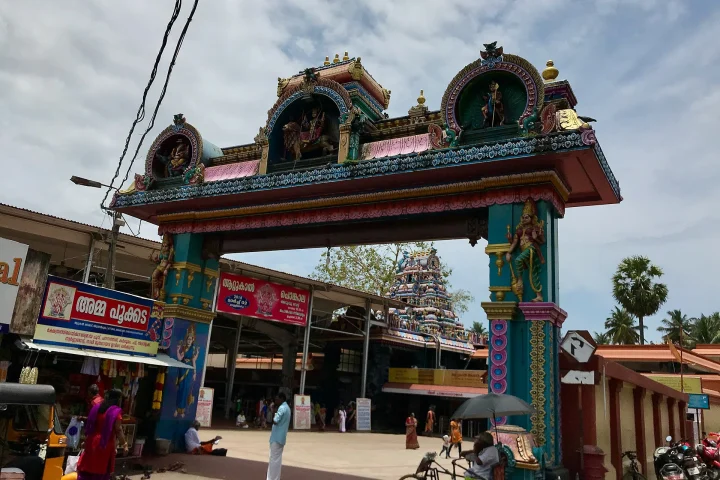
Inside the old East Fort of Thiruvananthapuram stands the temple that gave the city its name – Thiru-Anantha-puram, the town of the sacred serpent Anantha. The Sree Padmanabhaswamy Temple is one of the 108 Divya Desams of Vishnu, praised in the hymns of Nammalvar, and one of the 13 Divya Desams of the old Malai Nadu region.
It is also one of the most rule-bound temples in South India. Read the dress code and entry rules below before you travel, so your family reaches the sanctum without a last-minute problem at the gate.
On this page
Who may enter, and what to wear
Only Hindus are permitted inside the temple. This is the stated rule of the temple and is repeated by Kerala Tourism. Non-Hindu travellers in our groups can see the great gopuram and the Padmatheertham tank from outside, and visit the nearby Puthe Maliga palace museum.
Dress code (strictly enforced):
- Men: a mundu or dhoti reaching the heels, and no shirt or vest. A towel or angavastram over the shoulder is fine.
- Women: saree, mundum neriyathum (set mundu), skirt with blouse, or half-saree.
- Dhotis can be hired near the entrance. At the time of writing, wearing a dhoti over trousers or a churidar is allowed.
- Phones and cameras are not allowed inside. Leave them, with bags, at the counters outside or in the car.
The deity, seen through three doors
The presiding deity is Vishnu as Anantha Padmanabha, reclining in yogic sleep on the five-hooded serpent Anantha. Sridevi and Bhudevi are at his side, Brahma emerges on a lotus from his navel, and his right hand rests over a Shiva lingam – so the three gods of the Hindu trinity are seen together.
The image is about 18 feet long and, according to the temple’s tradition, is made of more than 12,000 saligrama stones from the Gandaki river in Nepal, bound with a special herbal compound. Because of its length, devotees see it through three doors: the face and chest through the first, the hands and navel through the second, and the feet through the third. Take your time at each door – the queue moves steadily, but each view is brief.
History in brief
The temple is mentioned in the Puranas and in the Tamil hymns of the Alvars, and its history is traced back many centuries. Its present form owes much to Marthanda Varma, the Travancore ruler who renovated it in the 18th century and re-consecrated the deity in 1731.
On 17 January 1750 he dedicated his entire kingdom to the deity – an act known as Thrippadidanam – and he and his successors ruled as Padmanabha Dasa, servants of Padmanabha. Since 2020 the temple has been managed by an administrative committee set up under directions of the Supreme Court of India, with the former Travancore royal family retaining a traditional role.
Architecture highlights
- The seven-tier eastern gopuram, about 100 feet tall, built in the Pandyan style and reflected in the Padmatheertham tank.
- The long eastern corridor lined with carved granite pillars, said to number 365 and a quarter.
- The Ottakkal Mandapam in front of the sanctum, carved from a single block of stone.
- A gold-covered flagstaff (dhwaja stambham), and the Navagraha mandapa with the nine planets carved on its ceiling.
Darshan tips
- Darshan runs in short sessions with closed periods in between. Plan to be in the queue 20–30 minutes before a session opens.
- The Nirmalya darshan, the first session of the day, is the most special – and the earliest queue.
- Carry only what you need: a little cash for offerings, and nothing that has to be deposited.
- Security checks at the gates are thorough. Smart watches and smart glasses have caused problems; leave them in the car.
- After darshan, it is a short drive to Attukal Bhagavathy Temple, about 2 km away.
Festivals
Two ten-day festivals are held each year: Painkuni in Meenam (March–April) and Alpashy in Thulam (October–November). Both end with the Arattu, when the deities are carried in procession to Shankumugham beach for a ritual bath, escorted by members of the former royal family. Navaratri brings the Swathi Sangeethotsavam, a classical music festival. Once in six years the temple celebrates Laksha Deepam, when a lakh of oil lamps is lit after 56 days of Vedic chanting (Murajapam).
How to reach
From Trichy: about 435 km, roughly 8–9 hours by road via Madurai and Tirunelveli.
From Pondicherry: about 690 km, 13–14 hours by road; we break the journey overnight, usually at Madurai or Trichy.
Thiruvananthapuram Central railway station is close to the East Fort, and Thiruvananthapuram International Airport is a short drive away. Many pilgrims from farther north take a train or flight to Thiruvananthapuram and use our car from there. See the Thiruvananthapuram temple-town guide.
Combine it with
- Attukal Bhagavathy Temple, the city’s great goddess temple.
- Kanyakumari Bhagavathy Amman Temple, about 90 km south – an easy pairing on the same trip.
- Our South Kerala temples tour, which links Padmanabhaswamy, Attukal and Kanyakumari from Trichy.
- The Kerala temple rules and dress code guide, and the full Divya Desam yatra.
Frequently asked questions
What is the dress code at Padmanabhaswamy Temple?
Men wear a mundu or dhoti reaching the heels with no shirt. Women wear a saree, set mundu, skirt and blouse, or half-saree. Dhotis can be hired at the entrance.
Can non-Hindus enter Padmanabhaswamy Temple?
No. Only Hindus are permitted inside. Non-Hindu visitors can see the gopuram and tank from outside and visit the nearby palace museum.
Are mobile phones allowed inside?
No. Phones and cameras must be left at the counters outside, or in your car, before you enter.
Why do we see the deity through three doors?
The reclining image is about 18 feet long, so it is viewed in three parts: the face through the first door, the hands and navel through the second and the feet through the third.
How far is Padmanabhaswamy Temple from Trichy?
About 435 km by road, roughly 8–9 hours via Madurai and Tirunelveli.